

In a crowded online marketplace, simply having a great product isn't enough to guarantee sales. If you want a direct path to growth, a well-executed PPC for e-commerce strategy is essential. Why? Because it places your products directly in front of motivated buyers at the exact moment they're searching for them. This approach delivers immediate traffic, measurable results, and a competitive edge that organic marketing alone cannot provide.
Why PPC is a Growth Engine for E-Commerce
Ever wonder how some online stores seem to gain visibility overnight? The secret is often a finely-tuned paid advertising strategy. While building an organic presence with SEO is a crucial long-term play, Pay-Per-Click (PPC) advertising is the engine that drives immediate, predictable revenue. It’s about meeting your customers exactly where they are, right when they're looking to buy.
Unlike SEO, which can take months to show significant traction, PPC campaigns begin delivering traffic and sales data from day one. This instant feedback is invaluable for an e-commerce business. You can quickly test a new product's viability, gauge market demand, and learn which marketing messages truly resonate with your target audience.
The Power of Purchase Intent
The real magic of PPC, particularly on platforms like Google Ads, is its ability to tap into purchase intent. When a potential customer searches for "women's black waterproof running shoes size 8," they aren't just browsing—they are on a mission to buy. PPC allows you to place your product directly in their path at this critical decision-making moment.
This level of precision is difficult to achieve with other marketing channels. It transforms your brand from a passive option into an active solution precisely when it matters most. For more actionable insights on building a powerful digital presence, feel free to explore the topics on the DigitalAdvertisingDirect blog.
This direct link to consumer needs is why so many businesses are investing heavily in paid search. Globally, companies allocate around 39% of their advertising budgets to paid search. A significant 32% of businesses use PPC specifically to sell products directly to consumers. This isn't a temporary trend; it reflects a fundamental shift in how people shop. With 21% of all retail purchases now occurring online, PPC has become a non-negotiable tool for converting digital traffic into real sales. You can explore these powerful PPC trends and their impact.
Key Takeaway: PPC isn't just about buying traffic; it's about buying highly-qualified, high-intent traffic. It creates a direct, measurable line between your ad spend and your sales revenue, giving you the hard data you need to scale your business intelligently.
Choosing the Right Battleground
Not all PPC platforms are created equal, and a smart e-commerce strategy involves selecting the right channels for your specific business goals. While Google Ads is often the starting point, other platforms offer unique opportunities to reach different customer segments. Identifying where your audience spends their time is the first step toward building a profitable campaign mix.
Here's a quick look at the key platforms you should be considering for your e-commerce business.
Key PPC Platforms for E-Commerce at a Glance
Deciding where to allocate your ad budget is one of the most critical decisions you'll make. This table breaks down the top platforms, their primary use cases, and the audience intent you'll find there.
| Platform | Primary Use Case | Audience Intent | Key Ad Formats |
|---|---|---|---|
| Google Ads | Capturing high-intent shoppers actively searching for products. | High (Active Search) | Shopping Ads, Search Ads, Performance Max |
| Meta Ads (Facebook & Instagram) | Building brand awareness and driving demand through visual discovery. | Low to Medium (Passive Discovery) | Image/Video Ads, Carousel Ads, Collection Ads |
| Microsoft Ads (Bing) | Reaching a slightly older, often higher-income demographic with less competition than Google. | High (Active Search) | Shopping Ads, Search Ads |
| TikTok Ads | Engaging a younger audience with creative, trend-driven video content to create viral demand. | Low (Entertainment-Driven) | In-Feed Video Ads, Spark Ads, TopView |
Each platform has its strengths. Google and Microsoft are excellent for capturing existing demand, while Meta and TikTok are powerhouses for creating new demand and building brand affinity. A truly effective strategy often involves a thoughtful combination of these channels.
Architecting a High-Performance PPC Campaign Structure
One of the biggest—and most costly—mistakes in e-commerce PPC is a disorganized account structure. Throwing all your products and keywords into one or two campaigns is a surefire way to burn through your budget with little to show for it.
A high-performing PPC for e-commerce account isn't just created; it's engineered. Think of it like merchandising a physical store. A local realtor in Boca Raton wouldn't mix listings for luxury condos with single-family homes; they'd segment them. Similarly, you wouldn't toss expensive electronics in the same bin as clearance socks. You create dedicated aisles and sections—"Men's Footwear," "Women's Outerwear"—to guide customers and understand what's selling. Your PPC campaigns require that same deliberate organization.
When you get this right, you unlock precise control over your budgets, write ad copy that truly resonates, and get clean, actionable data. It's the foundation for scaling profitably.
How to Segment Your Campaigns for Maximum Impact
There is no single "best" campaign structure. The ideal setup for a niche apparel brand will differ from that of a large electronics retailer. The goal is to segment in a way that aligns with your business objectives and provides strategic levers to pull.
Here are a few of the most powerful ways e-commerce stores can structure their accounts:
-
By Product Category: This is the most intuitive approach. Create distinct campaigns for "Hiking Boots," "Running Shoes," and "Sandals." This simple separation ensures your ads and landing pages for hiking boots are all about hiking boots—not generic footwear.
-
By Brand: If you sell products from multiple brands, this is a must. A search for a "Nikon DSLR Camera" shows different intent than one for a "Sony Mirrorless Camera." Splitting them into their own campaigns lets you tailor ad copy to each brand's unique selling points and target audience.
-
By Profit Margin: This is a more advanced, high-impact strategy. Isolate your high-margin "hero" products from your lower-margin or even loss-leader items. This is a game-changer. It allows you to confidently allocate more budget and bid more aggressively on the products that drive the most profit.
For example, a home goods store could run a high-priority campaign for its high-margin, custom-made furniture while running a separate, lower-budget campaign for mass-produced (and low-margin) kitchen gadgets. This strategic separation prevents your most profitable items from having their budget siphoned away by less important products.
The Power of Tightly-Themed Ad Groups
Once you've set up your campaigns, the next layer of precision comes from your ad groups. This is where relevance truly comes to life. The golden rule is simple: keep your ad groups small and tightly themed around a specific cluster of keywords.
Expert Insight: A common mistake is cramming dozens of loosely related keywords into one ad group. An ad group for "women's running shoes" should never contain keywords for "men's trail running shoes." This hurts your ad relevance and your Quality Score.
A great ad group focuses on one specific user need. Inside your "Hiking Boots" campaign, you might have hyper-focused ad groups like:
- "men's waterproof hiking boots"
- "lightweight women's hiking boots"
- "wide-fit hiking boots"
This granular structure allows you to write incredibly relevant ad copy. When someone searches for "waterproof" boots, your ad can state "Stay Dry on the Trail!"—directly answering their query and dramatically boosting your click-through rates.
This tight keyword-to-ad connection signals to Google that you're providing a great user experience. Google rewards this with a higher Quality Score, which often translates to a lower cost-per-click (CPC) and better ad positions. Suddenly, your campaign structure isn't just about organization; it's a powerful tool for improving performance and ROI.
Winning with Keyword Research and Product Feed Health

Your success with PPC for e-commerce ultimately hinges on two fundamentals: targeting the right keywords and maintaining a pristine product feed. Getting these right isn't just a "best practice"—it's the make-or-break factor between wasting your budget and building a profitable sales engine.
For e-commerce, keyword research is a different animal. It's not about casting a wide net with broad terms. It's about identifying the laser-specific, high-intent phrases that signal a shopper is ready to buy.
Uncovering High-Intent Keywords
The best keywords—the ones that truly convert—are almost always long-tail keywords. While a broad term like "men's shoes" will generate clicks, much of that traffic consists of casual browsers. The real value lies in long-tail keywords that tell you exactly what a customer wants.
Consider the difference in user intent:
- Broad: "running shoes" (This person is just starting their search.)
- More Specific: "men's trail running shoes" (They're narrowing it down.)
- High-Intent: "brooks cascadia 16 men's size 11" (They know what they want and are ready to buy.)
When you focus your bids on these detailed, long-tail keywords, your conversion rates will improve significantly. You're giving someone the exact product they just told Google they want.
A common mistake is allocating a large budget to broad, hyper-competitive keywords. A much smarter approach is to dedicate your budget to long-tail variations where competition is lower and purchase intent is sky-high. That's how you win profitable clicks.
As the market becomes more crowded, this kind of precision is essential. Global PPC spending is projected to reach an astounding $351.55 billion by 2025. This figure indicates that brands are moving beyond basic strategies and doubling down on advanced targeting that aligns with specific search intent. You can dig into more global PPC spending trends and what they mean for advertisers on DesignRush.com.
The Unsung Hero of Google Shopping: Your Product Feed
While sharp keyword targeting drives your Search ads, your product feed is the heart of your Google Shopping campaigns. This data file provides Google with every detail about your products. A clean, optimized, and rich feed is arguably the single most important element for success on Google Shopping.
Google relies entirely on this data to match your products to relevant searches. If your feed is weak, incomplete, or full of errors, your products simply won't appear for valuable searches—no matter how much you're willing to bid.
Your command center for this is the Google Merchant Center.
The "Diagnostics" tab is your first line of defense. It's where you'll find issues like item disapprovals or warnings that are quietly throttling your campaign's reach. Regularly monitoring and fixing these issues is a non-negotiable part of running an effective Shopping campaign.
Optimizing Your Product Feed for Maximum Visibility
Think of your product feed as a powerful marketing tool, not just a technical file. Every field is an opportunity to boost your ad's relevance and make it more compelling to a potential buyer.
Here’s a checklist for optimizing your most critical feed attributes:
-
Product Titles: This is your prime real estate. Don't just use the product name. A powerful formula is Brand + Product Type + Key Attributes (Color, Size, Material).
- Before: "Trail Shoe"
- After: "Salomon Speedcross 5 Men's Waterproof Trail Running Shoe – Size 10 – Blue"
-
Product Descriptions: Back up your title with more detail. Weave in secondary keywords and answer potential customer questions. Treat it like a mini sales pitch.
-
High-Quality Images: Your main image is the first thing a shopper sees. Use professional, high-resolution photos on a clean white background. Add extra images showing different angles or the product in use.
-
Accurate Product Category: Be as specific as possible with the Google Product Category. This is crucial for helping Google understand what you sell. Instead of
Apparel & Accessories > Shoes, drill down toApparel & Accessories > Shoes > Outdoor Shoes > Hiking Boots & Shoes. -
Custom Labels: This is your secret weapon for segmentation. Use custom labels to tag products by profit margin (
high_margin,low_margin), season (summer,winter), or sales velocity (bestseller,clearance). This lets you build campaigns and set bids based on what matters most to your bottom line.
For those with complex feeds, automating these optimizations can be a game-changer. That's precisely why we built our proprietary AdFuel Plus system, which can provide a serious competitive edge.
By meticulously refining both your keyword strategy and your product feed, you build a powerful foundation that drives highly qualified traffic and, ultimately, makes your campaigns more profitable. This is essential work for any e-commerce brand that's serious about growth.
Crafting Ad Copy and Landing Pages That Convert

Getting the click is a great first step, but it's only half the battle. You can have the most brilliant campaign structure and a killer keyword list, but if your ad copy doesn't resonate and your landing page can't close the deal, your efforts are wasted. This is where your PPC for e-commerce strategy truly starts turning traffic into profit.
Think of your ad copy as your digital storefront's first handshake. It must do more than just announce a product; it needs to grab attention, pre-qualify the visitor, and build a sense of urgency in just a few lines. The best ads mirror the searcher's intent and language while showcasing what makes the offer compelling.
Writing Ad Copy That Drives Action
The ad headline is the most valuable real estate in your entire campaign. Its primary job is to instantly reassure the searcher that they've found the right place. Paired with a compelling description that highlights your unique selling propositions (USPs), it becomes a powerful tool.
These small but mighty value propositions can dramatically lift your click-through rates:
- Free & Fast Shipping: Often the single deciding factor between you and a competitor.
- 24/7 Customer Support: Builds immediate trust and reassures buyers.
- Hassle-Free Returns: Removes purchase anxiety and reduces friction.
- Exclusive Discounts: A simple "Save 20% Today" can be incredibly persuasive.
For example, a boutique selling handcrafted leather bags can use ad copy that emphasizes quality. A headline like "Handcrafted Italian Leather Totes" speaks directly to their ideal buyer. The description can then seal the deal with something punchy: "Free Shipping | Lifetime Guarantee | Shop Now." This combination builds significant confidence before the user even clicks.
The Critical Importance of Message Match
So, they clicked. Now what? The journey from your ad to your landing page must be seamless. This concept, known as message match, is fundamental to converting visitors. If your ad promotes "50% Off Blue Running Shoes," your landing page must feature those exact blue running shoes with the 50% discount prominently displayed.
A disconnect between your ad and landing page is the fastest way to lose a sale. The user feels misled, their trust evaporates, and they hit the "back" button without a second thought. You've just wasted your ad spend and damaged your Quality Score.
This consistency reinforces the user’s decision to click and guides them smoothly toward a purchase. It’s a simple confirmation that they're in the right place and that the offer they clicked on is real and easy to claim.
Essential Elements of a High-Converting Landing Page
Your landing page isn't just another product page; it’s a focused conversion machine designed to do one thing: drive a sale. To build the necessary trust and momentum, every e-commerce landing page must include several key elements.
These components work together to answer questions, build confidence, and make buying easy:
- Crisp, High-Quality Imagery: Show your product from multiple angles, perhaps even in use. Allow people to zoom in and see the details.
- Clear, Transparent Pricing: No one likes surprises at checkout. Display the price, any discounts, and shipping costs upfront.
- Compelling Product Descriptions: Use benefit-driven language. Don't just list features; explain how the product solves a problem or improves the user's life.
- Visible Social Proof: Customer reviews, star ratings, and testimonials are modern word-of-mouth. Products with reviews have a significantly higher conversion rate for a reason.
- Trust & Security Badges: Display logos for secure payment options like Visa or PayPal and showcase your SSL certificate. These small icons tell customers their data is safe.
- An Unmistakable Call-to-Action (CTA): Your "Add to Cart" or "Buy Now" button should be bold, clear, and impossible to miss.
By connecting powerful ad copy with a frictionless, trustworthy landing page experience, you create a conversion funnel that actually works. This is the final, crucial step that turns your carefully managed ad clicks into measurable revenue.
Taking Campaigns to the Next Level with Advanced Optimization
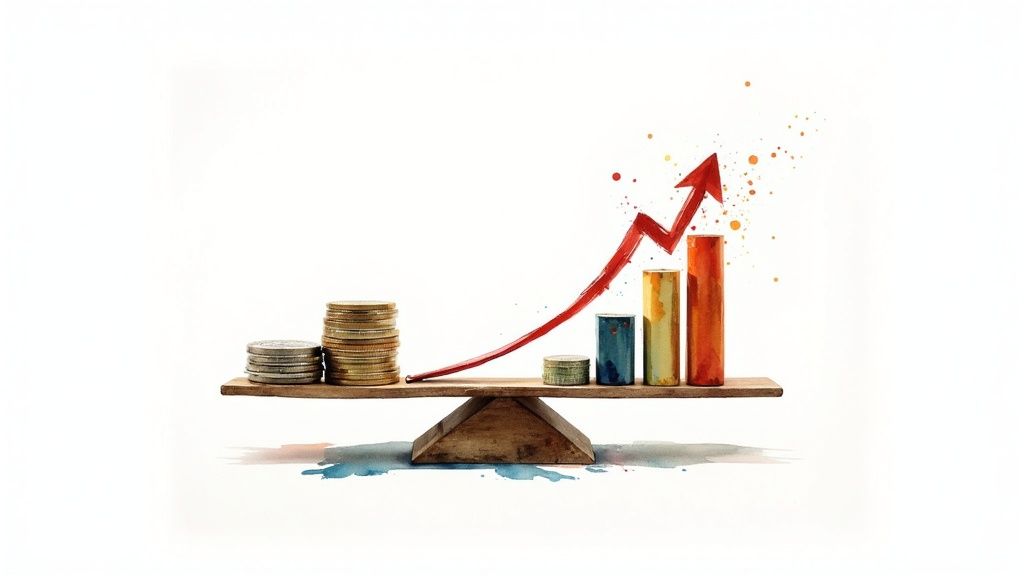
Getting your first campaigns live is a significant step, but the real work—and the real profit—is just beginning. In PPC for e-commerce, the difference between breaking even and building a true profit engine lies in relentless, data-driven optimization and smart scaling. This is where we move beyond the basics and make your ad spend work much harder for you.
This next phase starts with sophisticated bid management. Once you have a steady flow of conversion data, it's time to graduate from manual bidding and leverage Google's powerful automated strategies. These algorithms analyze thousands of signals in real-time to adjust your bids, a feat impossible to match manually.
Mastering Automated Bidding Strategies
For most e-commerce stores, two bidding strategies stand out: Target ROAS and Maximize Conversion Value. Your choice depends entirely on your business objectives.
-
Target ROAS (Return On Ad Spend): This is your go-to if profitability is your primary goal. You tell Google the exact return you need for every dollar you spend. For example, setting a target of $5 in revenue for every $1 in ad spend (a 500% ROAS) instructs the algorithm to maintain stable profit margins.
-
Maximize Conversion Value: This is a growth-focused strategy. Instead of aiming for a specific efficiency target, you’re telling Google to generate the most possible revenue from your budget, even if it means a lower ROAS on some sales. This is ideal when you want to aggressively increase total sales volume and market share.
Before you get lost in bidding strategies, don't forget one of the most powerful optimization tools: a rock-solid negative keyword list. Regularly check your Search Terms Report to find and block irrelevant queries. Every click on a term like "free running shoe patterns" when you sell running shoes is a dollar wasted. Plugging these budget leaks is one of the fastest ways to boost profitability.
ROAS vs. CPA Bidding Strategies for E-Commerce
When fine-tuning your campaigns, the choice between ROAS (Return On Ad Spend) and CPA (Cost Per Acquisition) bidding is a common crossroads. Both are powerful, but they serve different objectives. ROAS focuses on the value of the conversion, while CPA focuses on the cost of acquiring a customer, regardless of how much they spend. The table below breaks down the key differences.
| Bidding Strategy | Primary Goal | Best For | Potential Pitfall |
|---|---|---|---|
| Target ROAS | Maximize revenue while hitting a specific efficiency target (e.g., 500% return). | Businesses with varied product prices, focusing on overall profitability. | Can limit impression volume if the target is too aggressive. |
| Target CPA | Acquire a new customer at or below a specific cost. | Businesses with uniform product prices or lead-gen focused e-commerce. | Doesn't distinguish between high-value and low-value orders. |
Many seasoned e-commerce brands use both. They might use Target CPA for top-of-funnel campaigns to acquire new customers affordably and then switch to Target ROAS for bottom-of-funnel remarketing campaigns to maximize value from high-intent shoppers.
Using Audience Segmentation and Remarketing to Your Advantage
Keywords bring people to your site, but audience data turns them into loyal customers. Smart optimization involves segmenting your audience based on their interactions with your brand. This is the magic of remarketing—giving you a second, third, or even fourth chance to connect with people who are already familiar with you.
A well-built remarketing strategy should have multiple layers:
- Recent Website Visitors: A broad audience to keep your brand top-of-mind.
- Product Page Viewers: These people viewed specific items but didn't add them to their cart. This is a perfect opportunity to serve them dynamic ads showing the exact products they viewed.
- Shopping Cart Abandoners: This is your hottest audience segment. They were one click away from buying. A targeted ad with a gentle nudge, like a "10% Off to Complete Your Order" offer, can work wonders.
These advanced approaches are more critical than ever as the e-commerce space becomes more competitive. With mobile shopping exploding—an estimated 73% of e-commerce sales are expected to happen on mobile by 2025—having a sharp, mobile-first PPC strategy is non-negotiable. It's no wonder that 93% of marketers view PPC as a powerful tool for growth. You can discover more about these impactful PPC statistics and what they mean for retailers.
Expert Takeaway: True e-commerce PPC mastery comes from layering these tactics. Combine a strong negative keyword list with segmented remarketing audiences and a smart bidding strategy. This creates a multi-pronged approach that defends against wasted spend while aggressively pursuing profitable sales.
When you're ready to put these advanced strategies into action, a personalized consultation can illuminate the path forward. You can get professional guidance and book a free strategy session with our team to uncover new growth opportunities for your brand.
Finally, let's talk about scaling. Once a campaign consistently hits your ROAS goals, it’s time to add fuel to the fire. But scaling must be methodical. The biggest mistake is doubling your budget overnight. Instead, increase it incrementally—by about 20-25% every few days—while closely monitoring performance. This gives Google's bidding algorithm time to adjust without entering a lengthy "learning phase."
Pinpoint your winning products and move them into dedicated campaigns with their own budgets. This lets you push your most profitable items hard without being held back by lower-performing products. From there, you can methodically expand into new geographic areas or test related product lines, using your proven campaigns as the blueprint for success.
Your Top E-Commerce PPC Questions, Answered
When you're managing PPC for e-commerce, questions are inevitable. Even with a strong strategy, new challenges arise. This section tackles some of the most common questions from store owners, offering clear, actionable answers to help you refine your campaigns.
First, here's a simple way to diagnose what's going on if your campaigns aren't performing as expected. Think of it as a quick troubleshooting map.
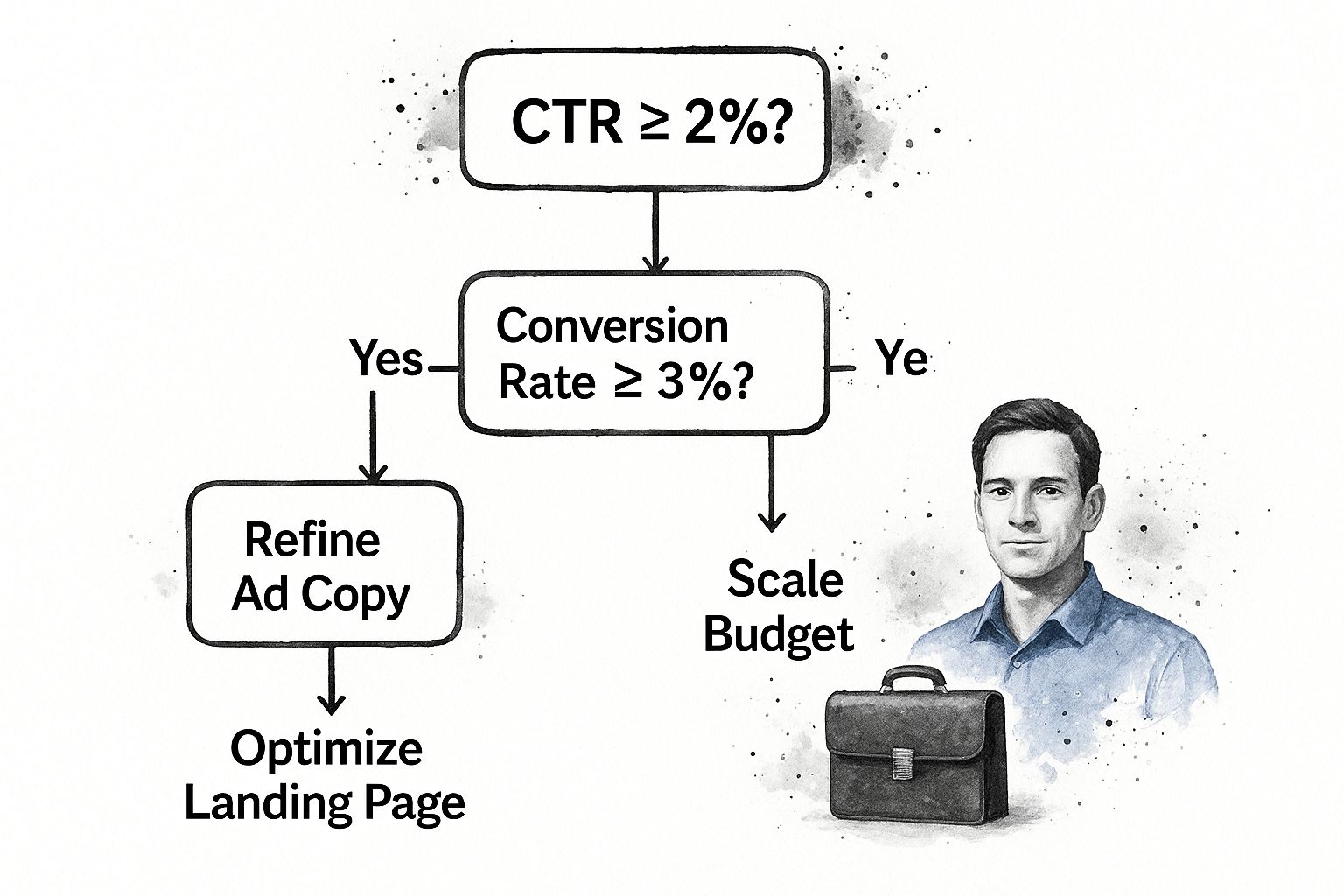
This chart simplifies the diagnostic process. If you're getting plenty of clicks but no sales, the issue is likely on your website. On the other hand, if your ads are being ignored and not getting clicks, it's time to revisit your ad creative and targeting.
How Much Should I Budget for My E-Commerce PPC Campaigns?
This is a common question, and the answer is: it depends. There’s no magic number that works for every store.
A smarter approach is to start with a test budget you're comfortable with—perhaps in the $500 to $1,500 per month range. The key is how you use it.
Instead of spreading that budget across every product, focus it on a small, hand-picked group of your most profitable items. In this initial phase, your goal isn't to get rich; it's to collect clean, reliable performance data.
Once you have that data, you can determine your break-even ROAS (Return On Ad Spend). As soon as you know that number and can prove profitability on a small scale, you can start confidently scaling your budget. Let the data—not guesswork—drive your spending decisions.
Should I Use Performance Max or Standard Shopping Campaigns?
This is a major strategic decision for anyone advertising on Google. For most businesses starting out or those wanting the widest reach, Performance Max (PMax) is the recommended path. It’s built on automation, pushing your ads across all of Google's properties, including Shopping, Search, YouTube, and Display.
However, that reach comes with a trade-off: control. PMax can feel like a "black box," making it difficult to add specific negative keywords or see exactly where your traffic is coming from.
This is why Standard Shopping campaigns remain valuable. You’ll want to stick with Standard Shopping if you:
- Need granular, product-level control over your bids.
- Have a sophisticated negative keyword strategy to implement.
- Must prioritize certain products or campaigns over others.
- Want to keep your Shopping traffic completely separate for cleaner reporting.
Many savvy advertisers use a hybrid approach. They run a PMax campaign to acquire new customers and build brand awareness, while also running highly-tuned Standard Shopping campaigns that focus only on their proven, high-margin winners.
My ROAS Is Low. What Are the First Things I Should Check?
Seeing a low Return On Ad Spend can be frustrating, but it’s usually a symptom of a fixable problem. Before pausing everything, run through this quick diagnostic list.
A low ROAS is rarely caused by a single issue. It's usually a combination of wasted ad spend on irrelevant clicks and a "leaky" post-click experience. The key is to systematically check each potential weak spot to find the root cause.
Here are the first three places to look:
- Product Feed Health: Head straight to your Google Merchant Center. Click on the "Diagnostics" tab and look for any item disapprovals or warnings. These errors can cripple your product visibility or stop ads from running entirely.
- Search Term Report: This is where you find opportunities. Dive into the Search Terms Report for your campaigns. Are you paying for clicks from searches that have nothing to do with what you sell? A store selling "Nikon DSLR cameras" might be wasting money on terms like "nikon camera repair." Add those to your negative keyword list immediately to plug the budget leak.
- Landing Page Experience: Look at your site through your customer's eyes. Is the page mobile-friendly? Is the price clear? Is the "Add to Cart" button impossible to miss? A slow, confusing, or untrustworthy landing page will demolish your conversion rate and your ROAS.
How Long Does It Take to See Results from PPC for E-Commerce?
PPC starts providing data almost immediately. Within hours of launching a campaign, you'll see impressions, clicks, and traffic. That instant feedback is one of its biggest strengths.
However, there's a difference between seeing data and seeing profitable results. It generally takes 30 to 90 days to gather enough performance data to make smart optimizations and achieve a stable, profitable return.
Think of the first month or two as a data investment phase. You're paying to discover which keywords convert, what ad copy resonates, and which products are your real winners. With patience and consistent analysis, you'll set yourself up for long-term success.
Want to simplify your ad campaigns and drive more sales? The team at Digital Advertising Direct specializes in building and optimizing high-performance PPC campaigns that deliver real revenue for e-commerce businesses. Discover our fully managed Meta and Google Ads solutions. Get a free strategy session with DigitalAdvertisingDirect today.