


Focusing on customer lifetime value (CLV) represents a fundamental shift in mindset. It’s about moving away from the short-term thrill of a single sale and toward the long-game of nurturing lasting relationships. The real, sustainable profit isn't found in that first transaction, but in the repeat business, referrals, and deep-seated loyalty that come after. This strategic pivot is arguably the most powerful way to build a predictable, healthy revenue stream for your real estate or small business.
This guide will break down actionable strategies for improving customer lifetime value, turning one-time clients into lifelong advocates.
Why CLV Is Your Most Important Growth Metric
It’s easy to get caught in the endless cycle of chasing new leads. While customer acquisition has its place, an obsession with it often means leaving a shocking amount of money on the table. The true engine of sustainable growth is hidden in plain sight: maximizing the value of the customers you’ve already earned.
This is where a focus on improving customer lifetime value becomes an absolute game-changer.
The Real Cost of Neglecting Existing Clients
Think for a moment about the resources—the time, ad spend, and sheer effort—that go into turning a stranger into a paying customer. Now, compare that to what it takes to get a happy, existing client to buy from you again. The difference is night and day.
The data backs this up. Acquiring a new customer can cost five times more than simply keeping an existing one. On top of that, your current customers are primed to spend more, and more often. One study found that existing customers spend roughly 67% more than new ones. The profitability is already locked inside your current client base.
For a deeper dive into these numbers, check out the valuable insights on the value of customer retention from MetricsWatch.com.
A Practical Scenario for a Local Realtor
Let's make this real. Imagine a realtor in Boca Raton who just helped a young family buy their first home. With a purely transactional mindset, the relationship ends when the commission check clears. The realtor is already back on the hunt, pouring their marketing budget into finding the next new buyer.
A CLV-focused approach changes everything. Instead of a one-off deal, the realtor sees a long-term relationship. This isn't just about the initial sale; it's about becoming the family's go-to real estate advisor for life.
By staying in touch with helpful market updates, home maintenance tips, and a "happy home-iversary" email, the realtor builds genuine trust. This simple shift unlocks a powerful stream of future revenue:
- Future Business: Five years later, when the family is ready to upgrade, they won't even think about searching for another agent.
- Referrals: When friends mention they're looking to buy or sell, this family will confidently pass along the name of their trusted realtor.
- Upselling Opportunities: The agent can become a hub of value, connecting the family with trusted partners for mortgages, insurance, or home renovations.
This shift from a single transaction to an ongoing relationship creates a powerful, self-sustaining cycle of revenue that relies less on expensive advertising and more on loyalty that can't be bought.
Core Levers for Improving CLV and Their Business Impact
| Strategy Lever | Primary Goal | Key Business Impact |
|---|---|---|
| Increase Purchase Frequency | Encourage existing customers to buy more often. | Drives consistent, predictable revenue and smooths out cash flow. |
| Increase Average Order Value (AOV) | Motivate customers to spend more on each transaction. | Boosts overall revenue and profit margins without needing more customers. |
| Improve Customer Retention | Keep customers loyal and engaged for a longer period. | Drastically reduces marketing costs and builds a stable customer base. |
| Boost Referral Rates | Turn happy customers into active brand advocates. | Creates a low-cost, high-trust customer acquisition channel. |
By strategically focusing on these levers, you move beyond just "making a sale" and start actively building a more resilient and profitable business.
How to Calculate and Understand Your CLV
Before you can boost your customer lifetime value, you need a real, honest number to work with. The term "CLV" might sound complex, but getting a baseline figure is surprisingly straightforward. It’s all about shifting your perspective beyond single sales to see the true long-term worth of your client relationships.
At its heart, the calculation hinges on three core metrics. This visual breaks down how Average Purchase Value, Purchase Frequency, and Customer Lifespan all flow together to define what a customer is really worth to your business.
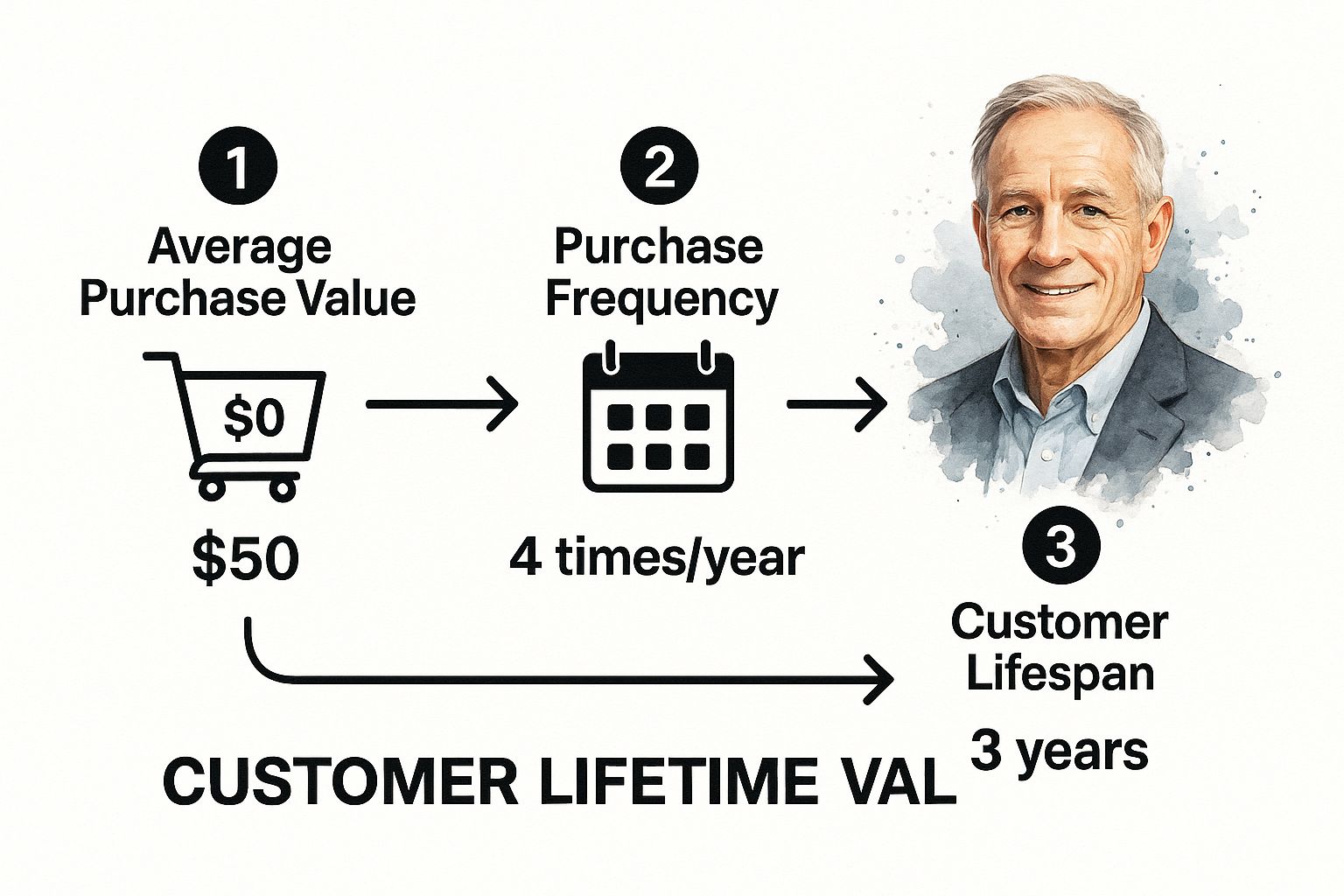
As you can see, multiplying these three components reveals the full revenue potential hidden in your existing customer base. It’s a game-changer that moves the focus from one-off wins to sustainable, long-term growth.
The Simple CLV Formula
You don't need fancy software to get a quick snapshot of your business's health. The basic formula is powerful.
(Average Purchase Value x Purchase Frequency) x Average Customer Lifespan = Customer Lifetime Value
Let's unpack this with a real-world example. Picture a local HVAC company.
- Average Purchase Value (APV): This is how much a customer spends on average each time they buy from you. If their clients spend an average of $300 per service call, that's their APV.
- Purchase Frequency (PF): How often does a customer buy from you within a given year? For this HVAC business, clients might book seasonal maintenance twice a year, making their PF 2.
- Average Customer Lifespan: This is the average number of years a customer sticks around. If this company typically keeps clients for 5 years, that's their lifespan.
Now, let's plug those numbers in:
($300 APV x 2 Purchases/Year) x 5-Year Lifespan = $3,000 CLV
That quick math reframes the situation. A $300 service call isn't just a one-and-done transaction; it's the start of a $3,000 relationship.
Why This Calculation Is a Business Imperative
Despite how critical this metric is, many businesses are flying blind. A whopping 89% of companies agree that CLV is a vital indicator of brand loyalty, yet only 42% can actually measure it accurately.
This gap is more dangerous than ever. Customer acquisition costs have exploded by over 222% in recent years, making customer retention the most economically sound strategy. When you consider that upselling and cross-selling already account for 31% of revenue for many businesses, a clear understanding of CLV becomes non-negotiable for profitable growth. You can dive deeper into these trends and their impact on customer value strategies on TipsonBlogging.com.
Knowing your CLV isn’t an academic exercise. It's the first step toward making smarter decisions about your marketing budget, customer service investments, and your entire growth plan.
Using Smart Segmentation for Improving Customer Lifetime Value
Once you have a solid grasp of your Customer Lifetime Value (CLV), it’s time to put that insight into action. The single biggest mistake businesses make is treating every customer the same. A brand-new lead and a loyal advocate who has been with you for a decade need completely different conversations.
This is where smart segmentation comes in, transforming your ability to improve customer lifetime value. It’s about creating targeted, relevant communication that speaks directly to where each customer is in their journey with your brand.
By grouping customers based on their CLV and behavior, you can invest your time and money more intelligently. Every marketing dollar works harder because the message is perfectly tuned for the person receiving it.
Creating Your Core Customer Tiers
The first step is to organize your customer base into a few simple, actionable tiers. This framework helps you prioritize your efforts. For most businesses, especially those in real estate or local services, these three segments are a powerful place to start.
- VIPs (High-CLV): Your champions. They are your most profitable, loyal clients who keep coming back and actively refer new business. They are vital to your long-term stability.
- Loyal Regulars (Medium-CLV): The backbone of your business. They're consistent, reliable customers who trust you. The goal is to nurture them toward becoming VIPs.
- At-Risk or Occasional Buyers (Low-CLV): Clients who've made small, infrequent purchases or haven't engaged with you in a while. They represent a huge growth opportunity if you can successfully win them back.
Actionable Strategies for Each Segment
With your segments defined, you can now build specific communication plans. The whole point is to deliver the right message at the right time to strengthen each relationship. For instance, a real estate brokerage would never send a first-time homebuyer prospect the same market update it sends to a seasoned multi-property investor.
The key is to match the value you provide to the value the customer brings. This shows you understand their needs and respect their relationship with your business—the foundation of loyalty.
Here’s a practical look at how to approach each group:
- Nurturing Your VIPs: Focus on retention and advocacy. Make them feel like insiders. Give them exclusive access, like an early look at new listings for a realtor or priority booking for a home service business. Don't underestimate personal communication—a quick phone call can work wonders.
- Engaging Your Loyal Regulars: The goal is to increase their purchase frequency and average order value. This is the perfect audience for upsells and cross-sells that genuinely add value. A mortgage broker could offer a client a valuable financial planning package, or we might suggest adding programmatic display ads to a client's existing Google Ads campaign.
- Re-engaging At-Risk Clients: Your mission is simple: bring them back. A personalized "we miss you" campaign with a compelling, time-sensitive offer can be incredibly effective. For a local restaurant, this might be a discount. For a B2B service, it could be a free audit or consultation to remind them of the value you offer.
Using AI to Deliver a Personal Client Experience
Not long ago, delivering a hyper-personalized experience to every client was a luxury only massive corporations could afford. Today, artificial intelligence (AI) has leveled the playing field, empowering small businesses and real estate pros to offer bespoke service that builds lasting loyalty.
AI allows you to automate thoughtful, relevant touchpoints that make every client feel seen and understood—without you manually juggling every interaction. The results speak for themselves. Companies that focus on CLV see a 27% higher retention rate and a 30% higher satisfaction rate. It's no wonder the global AI market is projected to hit $190 billion by 2025, with roughly 80% of companies convinced AI is essential for driving customer lifetime value. You can dive deeper into these AI trends and their business impact on SuperAGI.com.
How to Make AI Work for You
For business owners, AI is about using smart tools to anticipate client needs and act on them with precision. This technology is incredibly good at spotting patterns in customer data that a human could never catch, letting you be proactive.
Predictive analytics is a perfect example. AI models can sift through past behaviors to flag individuals who are starting to show signs of disengagement.
This is a total game-changer. Instead of finding out a client has churned after they're already gone, your system can alert you to the risk before it happens. That gives you a critical window to step in with a personal phone call or a well-timed re-engagement offer.
Automating Personalization at Every Step
The real magic of AI is its ability to manage personalized communication at scale. It takes you from sending generic email blasts to having meaningful one-to-one conversations—all on autopilot.
Here’s what this looks like in the real world:
- Anticipatory Emails: An AI-powered CRM, like our built-in AdfuelCRM, can track a client’s browsing activity. If a real estate client keeps looking at homes in a certain neighborhood, the system can automatically send them an email featuring new listings in that exact area.
- Intelligent Follow-ups: After a service call, an AI-driven system can send a tailored SMS asking for feedback. Depending on their reply, it can automatically ask for a review, offer a discount, or flag the conversation for your immediate attention.
- Relevant Service Suggestions: An AI tool might notice a client is pouring money into Google Ads but getting no social media traction. It could then prompt you to suggest a conversation about adding our targeted Meta Ads solutions to their marketing mix.
By weaving these smart tools into your process, you build an ecosystem where every client interaction is timely, relevant, and genuinely helpful. This is how you systematically improve customer lifetime value.
Driving Revenue with Upselling and Cross-Selling

Once you have a solid grasp on your client segments, it’s time to actively generate new revenue from the people who already trust you. This is where smart upselling and cross-selling transform client relationships into more profitable ones. It's a crucial part of improving customer lifetime value, but it's not about squeezing more money out of people. It’s about serving their needs on a deeper level.
The Art of the Relevant Upsell
Upselling is guiding a client toward a more premium version of something they're already buying. The secret is timing and relevance—making sure your offer solves a problem you know they have.
An upsell should never feel forced. It works best when it's presented as a solution that provides more value, efficiency, or a better outcome than the client's current option.
For instance, a mortgage broker who just helped a family secure their home loan could offer a comprehensive financial planning package. This builds on the decision they just made, helping them protect their new asset.
Expanding Value Through Cross-Selling
Cross-selling is about recommending complementary products or services that add value. Think of yourself as a hub of valuable solutions. A fantastic real-world example is a realtor who connects a new homeowner with a network of trusted local pros.
- Moving Companies: A direct introduction to a reliable moving company saves them hours of research.
- Home Services: A curated list of trusted painters, electricians, or plumbers is worth its weight in gold.
- Insurance Partners: Connecting them with an agent for a competitive quote on homeowner's insurance is another headache solved.
This strategy does more than just generate a potential referral fee. It positions the realtor as an indispensable local expert, all but guaranteeing future business and referrals.
Building Loyalty Beyond the Transaction
Ultimately, the most successful strategies for boosting customer lifetime value are rooted in unshakable loyalty. While upselling and cross-selling are fantastic for revenue, they must be built on genuine client care.
One of the best ways to do this is by actively listening to and acting on client feedback. When clients feel heard, it builds a powerful emotional connection that a competitor's discount can't touch. This feedback loop is also a goldmine, helping you spot opportunities for new services and refine your current offers.
Putting It All Together: Your Sustainable Growth Blueprint

We've covered a lot of ground, from data analysis to building lasting customer relationships. Now, it's time to draw up your own strategic blueprint for growth. The framework we've laid out is a complete roadmap. It begins with measuring what truly matters and segmenting your audience so you can speak to them with relevance.
The real magic happens when you realize that improving customer lifetime value is all about building authentic, long-term relationships. Those connections fuel predictable revenue, create a powerful referral engine, and make your business resilient.
When you start focusing on the entire client lifecycle, you stop chasing short-term wins and begin building a more stable, profitable, and sustainable business. If you need a hand putting these strategies into practice, check out our fully managed digital advertising solutions.
CLV Questions on Your Mind?
As you start shifting your focus toward a CLV-driven strategy, it’s normal for a few questions to pop up. Let's tackle some of the most common ones we hear.
Is CLV Just a Fancy Term for Customer Satisfaction?
Not quite, though they are closely related. Customer satisfaction is a snapshot in time—it measures how a client feels about a specific interaction.
Customer Lifetime Value (CLV) is the long game. It’s the total revenue you can expect from a client over the entire time they do business with you. High satisfaction is a crucial ingredient for a high CLV, but they aren't the same thing.
How Often Should I Be Calculating CLV?
For most businesses, running the numbers quarterly or semi-annually hits the sweet spot. This is frequent enough to catch important trends without getting buried in spreadsheets. However, if your business moves faster—like in e-commerce or during a big marketing push—a monthly check-in can provide the real-time feedback you need.
What Are Some Simple Ways to Start Improving CLV Today?
Boosting your customer lifetime value doesn't have to mean a complete operational overhaul. You can start with a few simple, high-impact actions right now.
- Humanize your follow-ups. Go beyond the automated receipt. Send a quick, personal email asking for feedback or sharing a helpful tip.
- Roll out a simple loyalty offer. Identify your top 10% of customers and give them a small, exclusive discount or a sneak peek at a new service.
- Don't be shy about referrals. The next time a client gives you great feedback, politely ask if they know anyone else who could use your help.
Want to simplify your ad campaigns? Discover our fully managed Meta and Google Ads solutions. Get a free strategy session with DigitalAdvertisingDirect.