

Every insurance agent wants a full pipeline, but many jump straight to spending money on ads only to wonder why the leads are low-quality or nonexistent. The truth is, mastering how to get insurance leads that actually convert starts with a rock-solid digital foundation, not a big ad budget.
It’s about creating a well-oiled system that pinpoints your ideal client, builds instant trust, and tracks every interaction. Nailing this groundwork is what ensures every marketing dollar you spend has the best possible chance of turning into a loyal, long-term client.
Building Your Foundation for Quality Insurance Leads
Before you can figure out how to get insurance leads that close, you have to build the infrastructure to support them. Think of it like building a house: you wouldn't install expensive windows before the foundation is poured and the walls are framed. The same logic applies to your marketing.
Skipping this foundational stage is the most common mistake we see agents make, and it leads directly to wasted ad spend and frustration. Sending traffic to a clunky, untrustworthy website is like pouring water into a bucket full of holes. The goal is to create a seamless, professional digital experience that grabs a prospect's interest and guides them to take action.
Define Your Ideal Client Profile
You can't be everything to everyone. The most successful agents have a crystal-clear picture of who they're trying to reach. This goes beyond basic demographics like age and location. A powerful Ideal Client Profile (ICP) digs into the why—the psychographics and behavioral triggers that motivate your target market.
For example, a sharp agent might define their ICP like this: "A local realtor in Boca Raton might target dual-income couples, aged 30-40, who recently bought their first home. The life event of buying a home has triggered them to actively research home and life insurance online to protect their new mortgage."
That level of detail becomes your North Star for everything—from the ad copy you write to the blog topics you create.
Key Takeaway: A detailed Ideal Client Profile is your strategic compass. It ensures your marketing message resonates deeply with the prospects most likely to convert, saving you time and money.
Craft a Professional, Mobile-First Website
Your website is your digital storefront. For most prospects, it's their first impression of your agency. With over 60% of all website traffic now coming from mobile devices, a clunky mobile experience isn't just an inconvenience; it's a lead killer.
Your site must be a lean, mean, lead-generating machine. Make sure it's equipped with:
- Clear Trust Signals: Prominently display your license number, client testimonials, professional affiliations (like NABIP), and the logos of carriers you partner with. This builds immediate credibility.
- Frictionless Contact Forms: Keep your forms short. At first, you only need the essentials: name, email, and phone. A long, complicated form is a guaranteed conversion killer.
- Compelling Calls-to-Action (CTAs): Every page should have a clear purpose. Guide visitors with action-oriented buttons like "Get a Free Quote Now" or "Schedule a 15-Minute Consultation."
Implement Essential Analytics Tracking
You can't improve what you don't measure. In digital marketing, this is gospel. Without data, you’re flying blind, guessing at what works and what’s a waste of money.
Setting up Google Analytics is the bare minimum. It’s your window into how people behave on your site—which pages they visit, how long they stick around, and where they came from. By setting up conversion goals, you can track exactly how many visitors fill out a form or click to call you. This data is the key to optimizing your campaigns and proving your return on investment (ROI). Analyzing these metrics is fundamental if you want to master how to get insurance leads effectively.
How to Get Insurance Leads Now with Paid Advertising
While building a long-term digital presence is smart, sometimes you just need leads now. This is where paid advertising changes the game. It’s the fastest, most direct path to getting your agency in front of prospects actively looking for the insurance products you sell.
Think of it less as an expense and more as a strategic investment. When done right, paid ads create a predictable, immediate stream of high-quality inquiries. Let's break down how to launch campaigns that capture ready-to-buy prospects without burning through your budget.
Winning on Google with High-Intent Keywords
When someone types "local auto insurance agent" or "term life insurance quotes online" into Google, they aren't just browsing. They have a specific need and are looking for a solution right now. This is what we call high-intent, and capturing it is the entire point of Google Ads. Your job is to be the best answer to their search.
Success here boils down to thinking like your ideal client. What would they type into the search box when they’re serious about talking to an agent?
- For a local agent in Boca Raton: A broad term like "car insurance" is a waste of money. Target a money phrase like "best car insurance rates Boca Raton."
- For a life insurance specialist: Get specific. Target real-life needs with keywords like "life insurance for new parents" or "30 year term life insurance quote."
Once you have your keywords, your ad copy must match that intent perfectly. If they searched for a local agent, your headline should promise one: "Your Local Boca Raton Insurance Pro." That direct relevance is what earns the click and starts the conversation.
Targeting Life Events with Meta Ads
On Meta platforms like Facebook and Instagram, the strategy flips. You're not capturing existing demand; you're creating it by interrupting someone’s social media scroll. It's less about what they're searching for and all about who they are and what’s happening in their life.
Meta’s power lies in its detailed audience targeting, especially around major life events that trigger insurance needs. For example, you can build campaigns that specifically target people who are:
- Recently Married: A prime time for couples to review policies or get the life insurance they’ve been putting off.
- New Homeowners: A perfect opportunity to bundle auto and other policies.
- Expecting Parents: The need for robust life and health insurance becomes a top priority.
- Starting a New Business: This opens the door to conversations about commercial liability and other business policies.
By zeroing in on these life-event audiences, you get your message in front of people at the exact moment their insurance needs are top of mind—often before they even search on Google.
Another effective tactic is creating Lookalike Audiences. You can upload a list of your best clients, and Meta’s algorithm will find new people who share similar online behaviors. It’s like creating a clone of your most valuable customers. To get the most out of these powerful but complex strategies, many agencies have us manage the heavy lifting through our AdFuel Plus program.
The proof is in the numbers. The insurance industry's investment in digital advertising is massive for a reason—it works. In 2021, the sector spent a staggering $11.7 billion on digital ads, a figure that climbed to an estimated $12.51 billion in 2022. The takeaway is clear: agencies that invest over 15% of their revenue in lead generation see significant growth, while those spending under 5% are nearly three times more likely to have their revenue stagnate.
Digital Advertising Channel Comparison for Insurance Agents
Choosing where to spend your ad dollars can be overwhelming. This table breaks down the main channels to help you decide where to focus based on your goals.
| Channel | Best For | Targeting Capabilities | Typical Cost Model |
|---|---|---|---|
| Google Ads | Capturing high-intent prospects actively searching for insurance. | Keyword, location, demographics, remarketing. | Pay-Per-Click (PPC) |
| Meta (Facebook & Instagram) | Generating new demand by targeting users based on life events and interests. | Demographics, life events, interests, behaviors, Lookalike Audiences. | Cost-Per-Impression (CPM) or PPC |
| LinkedIn Ads | Reaching B2B prospects, high-net-worth individuals, and business owners. | Job title, industry, company size, professional groups. | PPC or CPM |
| Local Services Ads | Hyper-local targeting for agents who want "Google Guaranteed" trust. | Service area, insurance type. | Pay-Per-Lead (PPL) |
Ultimately, a mix of channels is often the most effective approach. Start with Google to capture low-hanging fruit, then layer in Meta to build a pipeline of future clients.
The chart below shows a typical agency's monthly leads from different social platforms, highlighting where the volume often lies.
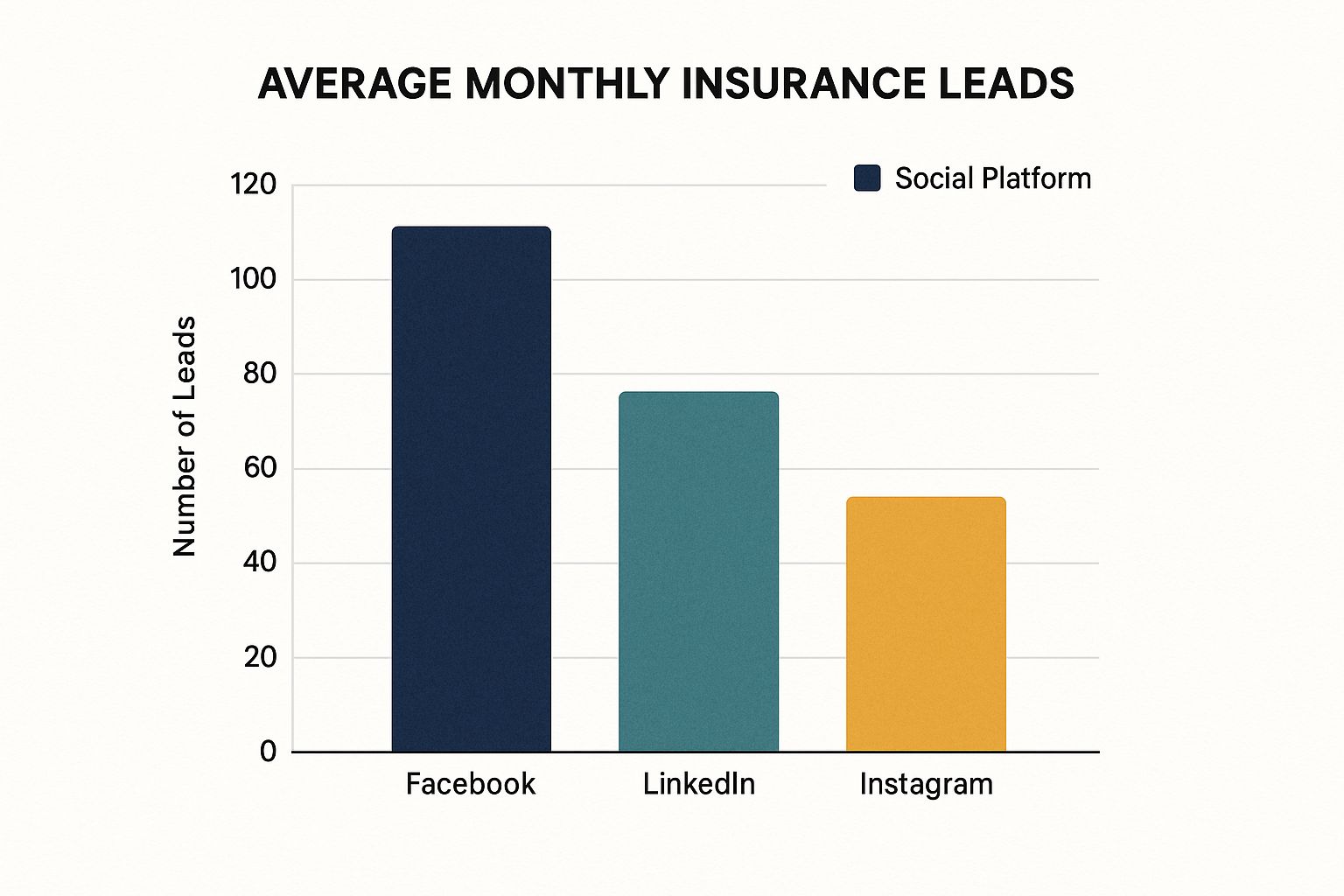
As you can see, Facebook's massive user base and life-event targeting frequently make it the top producer for consumer-focused insurance leads like auto, home, and life.
Using Modern Tools to Capture and Nurture Leads

Getting traffic to your website with paid ads is only half the battle. A click is just potential. The real work starts the second a prospect lands on your page. Your ability to turn that click into a conversation is what separates thriving agencies from those just getting by.
This is where technology becomes your most valuable employee. Speed is the ultimate competitive advantage. In a market where prospects request quotes from multiple sites, the first agent to respond almost always wins. This makes instant engagement tools non-negotiable if you're serious about figuring out how to get insurance leads today.
Capitalize on Every Click with Instant Engagement
You can't be available 24/7, but your digital tools can. AI-powered chatbots and live chat functions act as your digital front desk, capturing interest in real-time. No more opportunities slipping through the cracks.
The impact of responsiveness is staggering. Today’s consumers expect immediate answers. A ReveChat.com report on insurance responsiveness shows that 78% of insurance buyers purchase from the first company that responds. This statistic shows why waiting even an hour to follow up is a costly mistake.
To make these tools work, configure them to ask pre-qualifying questions:
- "What type of insurance are you looking for today? (Auto, Home, Life, etc.)"
- "Are you currently insured?"
- "What's the best way to contact you for a no-obligation quote?"
This initial triage ensures you spend your valuable time on prospects who have already shown real intent.
Automate Trust with Smart Email Nurturing
Not everyone is ready to buy the second they fill out a form. A well-designed email nurturing sequence is your secret weapon for staying top-of-mind. Think of it as an automated relationship-builder.
Pro Tip: A simple, three-part email sequence can dramatically increase your connection rate. It positions you as a helpful expert, not just another salesperson, and keeps your name at the top of their inbox.
A powerful sequence could look like this:
- Email 1 (Immediate): Confirm their request and provide immediate value, like a link to a helpful blog post ("5 Common Mistakes When Buying Home Insurance").
- Email 2 (2 Days Later): Share a client success story or a powerful testimonial related to their inquiry. This builds social proof and trust.
- Email 3 (4 Days Later): Offer a direct, no-pressure call-to-action to connect, linking directly to your calendar to make scheduling effortless.
This automated system creates consistent communication, nurtures lukewarm leads into hot prospects, and frees you up to focus on closing deals. For those who want to take the guesswork out of scheduling, you can book a free strategy session to see how our systems can automate this entire process for you.
Driving Long-Term Growth with Content and SEO
While paid ads deliver instant leads, they work like a faucet—turn off the spend, and the flow stops. A smart content and search engine optimization (SEO) strategy, on the other hand, is a permanent asset that keeps generating leads long-term.
This approach builds a sustainable pipeline of high-intent prospects who find you organically. It's one of the most powerful ways how to get insurance leads because it cements your agency as the go-to expert in your market. It takes time, but the payoff is a steady stream of free, high-quality inquiries.
Uncovering What Your Clients Are Asking Google
The foundation of a winning content strategy is knowing the exact questions your ideal clients are typing into Google. Your job is to become the best answer to their most urgent insurance questions. When you do that, you grab their attention at the start of their search.
Key Insight: People don't search for policy numbers; they search for solutions to life's problems. Answering their questions directly is the fastest way to build trust and earn their business.
You can build effective content around real-world questions your clients have, such as:
- "What kind of life insurance do I need in my 30s?"
- "How can I lower my home insurance costs?"
- "Is umbrella insurance worth it for a new family?"
- "Best auto insurance for teenage drivers in [Your City]."
Creating Content That Genuinely Helps (and Converts)
Once you have your list of questions, create genuinely helpful, high-quality content that gives clear, actionable answers. This usually means writing blog articles or in-depth guides for your website. Think of every piece of content as another digital signpost pointing potential clients to your agency.
Focus on delivering real value, not a hard sell. For example, an article titled "5 Smart Ways to Lower Your Home Insurance Premium in Florida" will attract more interested homeowners than a generic page listing your services. When you give away useful information, you establish expertise and make people more receptive when it's time to talk policies. For more practical examples, check out the articles on the DigitalAdvertisingDirect.com blog.
Dominating Local Search with Hyper-Specific Location Pages
For most agents, business is local. Creating dedicated "location pages" on your website is a highly effective SEO tactic for attracting clients in your backyard. A powerful location page is customized for a specific town, mentioning local landmarks, community-specific risks (like hurricane preparedness for a coastal town), and testimonials from local clients. This sends a massive signal to Google that you are the relevant authority for searches like "insurance agent near me" or "home insurance in [City Name]."
Owning Your Local Map with a Killer Google Business Profile
Your Google Business Profile (GBP) is your most important tool for local SEO. It’s the free listing that gets your agency into the coveted "map pack" at the top of local search results. A fully built-out profile is like a mini-website right on Google.
At a minimum, you must have:
- Complete and Accurate Info: Your agency name, address, phone number (NAP), and business hours must be 100% correct and consistent everywhere online.
- High-Quality Photos: Add professional photos of your office, team, and logo to build immediate trust.
- A Steady Stream of Reviews: Proactively ask happy clients for a Google review. Positive reviews are a huge trust signal for both prospects and Google's ranking algorithm.
Time to Scale: Advanced Strategies for Serious Lead Generation

Once your marketing engine is humming, it's time to shift from building a pipeline to truly scaling it. Getting to the next level means moving beyond your direct efforts and adopting more sophisticated tactics to open up new, high-velocity streams of business.
Navigating the Murky Waters of Purchased Leads
Buying insurance leads has a reputation, but it can be a phenomenal investment when approached strategically. The trick is to treat it with the same diligence you'd apply to any other marketing channel.
Vet any lead provider by asking tough questions:
- Are the leads exclusive? Shared leads are cheaper but kick off a brutal race to the bottom on price.
- How is the data verified? Do they confirm the contact info is accurate and that the prospect genuinely requested a quote?
- What's the return policy? A good partner will have a fair policy for crediting you for bogus leads.
Red Flag Warning: If a provider promises a mountain of leads for pocket change, run. High-quality, exclusive leads cost more because they convert at a much higher rate, giving you a far better return on your investment.
Unlock Hidden Gold with Data Enrichment
One of the most potent scaling strategies is data enrichment. It's simple: you enhance the customer data you already have with third-party information to spot new opportunities. It’s like putting on X-ray glasses that reveal hidden needs within your current book of business.
For example, run your list of auto-only clients through an enrichment service. You might find that 30% are also homeowners. Now you can launch a laser-focused campaign with a compelling offer to bundle their home and auto. This is how you proactively create revenue instead of just waiting for the phone to ring.
Building a Powerful Referral Engine
The ultimate goal is a referral machine that runs on its own. Creating strategic partnerships with other professionals automates the process and generates a steady flow of warm, high-trust introductions.
The most successful partnerships for insurance agents are with:
- Mortgage Brokers and Loan Officers: Every person getting a new home loan needs homeowners insurance.
- Real Estate Agents: Realtors are on the front lines with new buyers who need coverage yesterday.
- CPAs and Financial Advisors: These pros are in a prime position to spot gaps in life, disability, or liability coverage.
Building these advanced systems is the definitive answer to how to get insurance leads at a scale that transforms your business.
Lead Generation Strategy ROI Potential
| Strategy | Upfront Cost | Time to See Results | Long-Term Scalability |
|---|---|---|---|
| Paid Advertising | Medium to High | Immediate | High (with budget) |
| SEO | Low to Medium | 6-12+ Months | Very High |
| Purchased Leads | Medium to High | Immediate | Medium |
| Referral Partnerships | Low | 3-6 Months | High |
| Data Enrichment | Low to Medium | 1-3 Months | Very High |
The "best" strategy depends on your immediate needs and long-term goals. A balanced approach, combining a fast-acting method like paid leads with a long-term asset like SEO, often yields the most sustainable growth.
Your Top Insurance Lead Gen Questions, Answered
Even with a solid plan, questions pop up when you get into the nitty-gritty of lead generation. Getting straight, no-fluff answers helps you move forward and see results. Let's tackle the most common questions we hear from agents trying to crack the code on how to get insurance leads.
What Is the Best Type of Insurance Lead to Buy?
Hands down, the best leads are exclusive, real-time leads. This means the second a prospect hits "submit," their info lands directly in your inbox—and yours alone. That exclusivity is everything. It gives you the first real chance to connect before other agents start blowing up their phone.
Shared leads are cheaper, but you get what you pay for. When a lead is sold to multiple agents, it triggers a race to the bottom on price. It's a tough game to win.
My Two Cents: Never work with a lead provider that doesn't have a clear process for returning bogus leads. If you get a disconnected number or fake info, you shouldn't have to pay for it. A good partner stands by the quality of their data.
How Much Should an Insurance Agent Spend on Marketing?
There's no single answer, but a solid rule of thumb for growth-focused agencies is to earmark 5-10% of your desired revenue for marketing. This is enough to test a few channels, find what works, and then double down on the winners.
For a new agent or a tighter budget, a fixed monthly ad budget of $500 to $1,500 is a great starting point. This gives you enough runway to get real data from platforms like Google or Meta Ads and prove you're getting a positive return. Remember to balance paid strategy with "sweat equity" in free channels like local SEO and referral networking for long-term growth.
Is Social Media Effective for Getting Insurance Leads?
Absolutely, but you need a different mindset. On social media, you’re creating demand, not just fulfilling it. You're interrupting someone's scroll, so your message must be compelling and perfectly targeted.
The magic of social media lies in targeting people based on major life events—the very things that create an immediate need for insurance. Think about the power of building custom audiences of people who are:
- Recently engaged or married
- Expecting a baby
- New homeowners
- Starting a business
When you put a relevant message in front of these specific groups, you’re not just another ad. You’re a solution that arrives at the perfect time.
Ready to stop guessing and start getting a predictable stream of exclusive, high-intent insurance leads? Learn how DigitalAdvertisingDirect can help you capture more leads today. Get a free strategy session today and see how our fully managed Meta and Google Ads solutions can fuel your agency's growth.