

Learning how to generate leads online isn't about finding a secret hack; it's about consistently delivering the right value to the right people on the right platform. It’s a strategic system, not a game of chance. Are you spending marketing dollars without seeing a reliable stream of potential customers? If you don't start with a crystal-clear understanding of what your ideal client truly needs, every ad you run and every piece of content you create is a shot in the dark.
The Modern Playbook for Generating Leads Online
Are you burning through your marketing budget without seeing tangible leads in return? You’re not alone. Too many businesses throw ads into the digital void, cross their fingers, and hope for the best, only to be met with disappointing results. This "spray and pray" approach lacks the data-driven strategy required to consistently attract high-quality prospects.
This guide provides a clear, actionable roadmap to build a lead generation engine that delivers results. We'll show you how to truly understand your audience, select the best platforms for your business—whether you're a realtor, a local service provider, or a marketing manager—and craft value-driven content that captures attention.
Why a System Always Beats Sporadic Efforts
An effective lead generation plan isn't a one-off campaign; it's a repeatable process that builds momentum.
Consider a local realtor in Miami. Instead of simply boosting a new listing on Facebook and hoping the right person sees it, she creates a downloadable guide: "5 Things First-Time Homebuyers in Miami Must Know." This single piece of content does the heavy lifting. It attracts her ideal audience (first-time buyers) and begins building trust long before she ever mentions a specific property.
That’s the difference between casting a wide, empty net and using targeted, effective bait.
The goal is to create a predictable flow of potential customers. To achieve this, your strategy must connect every touchpoint—from the first ad a prospect sees to the landing page they visit and the follow-up they receive. Each step must be deliberately designed to move them closer to becoming a client. Our various articles on the DigitalAdvertisingDirect.com blog dive deeper into these individual components.
Key Takeaway: The most effective lead generation isn't about a single magic bullet. It's about building an interconnected system where your audience targeting, offer, and follow-up work together seamlessly to produce predictable results.
The Real Cost and Opportunity in Lead Generation
Acquiring new business is the top priority for nearly every company. In 2025, lead generation remains the primary focus for half of all marketers, with businesses generating an average of 1,877 leads each month.
But that effort comes with a price. The average cost to acquire a single lead is a significant $198.44.
With 76% of marketers using content and 68% leveraging social media, the digital landscape is clearly where the action is. However, a staggering 44% of sales teams admit they are often too busy to follow up on these leads properly. This reveals a critical gap in the process. It's not just about generating leads; you need efficient systems to ensure they are nurtured effectively. You can explore more data on these lead generation trends to get the full picture.
It’s time to stop wasting ad spend and start building a system that fuels real, measurable business growth.
Building Your Foundation: How to Generate Leads Online with an Ideal Customer Profile
Before you invest a single penny in an ad campaign, you must be crystal clear on one thing: who, exactly, are you trying to reach?
If your answer is vague, like "homeowners" or "small business owners," you're setting yourself up to burn through your budget. Learning how to generate leads online effectively starts with a detailed Ideal Customer Profile (ICP).
This goes beyond basic demographics like age and income. A powerful ICP delves into psychographics—the goals, pain points, and motivations that drive your best customers to seek a solution like yours. It’s the difference between shouting into a crowded stadium and having a targeted conversation with someone already looking for you.
Without this clarity, your ads will feel generic, your targeting will be imprecise, and your cost per lead will skyrocket. Your ICP is the blueprint for every marketing decision you make.
Moving Beyond Basic Demographics
Many businesses stop at the surface level. Real performance, however, comes from understanding the human being on the other side of the screen. An effective ICP blends quantitative data with qualitative insights, combining what you can measure with what you understand about their daily lives.
For example, a realtor in Boca Raton needs to know more than a prospect's budget. She needs to understand their aspirations. Are they downsizing empty-nesters seeking a low-maintenance condo, or a growing family focused on finding a home in the best school district? What keeps them up at night about the home-buying process?
The same applies to a local electrician. The ICP isn't "anyone with a house." It's the homeowner who prioritizes safety over a cheap fix, feels overwhelmed by DIY videos, and needs a trustworthy professional to solve an urgent problem.
Your Ideal Customer Profile is a living document, not a one-time assignment. As your business evolves and the market shifts, you should continuously refine it with fresh data from your CRM, customer feedback, and campaign results.
Key Components of a Robust ICP
To build a profile that delivers real-world results, focus on these crucial areas. This framework ensures your messaging, offers, and ad targeting are perfectly aligned with the people you want to attract.
- Pain Points & Challenges: What problems are genuinely disrupting their day? For a financial advisor’s ideal client, it might be the fear of outliving retirement savings. For a dentist’s prospect, it’s the immediate pain of a toothache.
- Goals & Motivations: What are they ultimately trying to achieve? This goes deeper than solving a problem. Someone hiring a roofer isn't just stopping a leak; they are motivated by the desire for a safe, secure home for their family.
- Watering Holes: Where do they spend their time online? This is invaluable. Knowing if your audience trusts recommendations from a local Facebook group or follows specific influencers on Instagram tells you exactly where to place your ads.
- Purchase Triggers: What event pushes them to finally take action? It could be a major life event like a promotion or a new baby, or an acute problem like the AC breaking down in July.
When you map these elements out, you stop seeing a generic "target audience" and start seeing a multi-dimensional person. This profile becomes your North Star for writing ad copy that resonates and creating offers they can't refuse—which is the key to successfully generating leads online.
Choosing Your Channels: Where to Find Your Ideal Customers
Now that you know who you’re trying to reach, it’s time to find them. The biggest mistake businesses make is the "spray and pray" approach—scattering a little money across every platform and hoping something sticks.
That’s not a strategy. A real strategy involves placing smart bets on the channels where your Ideal Customer Profile (ICP) spends their time and, more importantly, where they are receptive to your message.
Knowing how to generate leads online isn't about being everywhere. It's about being in the right places.
The channel you choose dictates everything: the ads you can run, the people you can target, and their mindset when they see your message. Someone frantically searching on Google has a completely different intent than someone casually scrolling through Instagram. Your approach must align with that user's intent to see a positive return.
Capturing High-Intent Prospects with Google Ads
When people have a problem they need to solve now, they turn to Google. That's what makes Google Ads a powerhouse for capturing high-intent leads—you’re meeting people who are actively searching for the solution you offer.
Think about a homeowner in Phoenix whose air conditioner just failed in July. They aren't browsing Facebook; they're on their phone, typing "emergency AC repair Phoenix" into the search bar. An HVAC company with a smart search campaign can be the first result they see, capturing that lead at the peak moment of need.
This is intent-based marketing. You aren't creating demand out of thin air; you are claiming the demand that already exists.
- Best For: Local service businesses (plumbers, electricians, roofers), real estate agents targeting specific searches ("homes for sale in downtown Austin"), and any company solving an immediate, urgent problem.
- Key Advantage: You connect with users who are problem-aware and actively seeking a solution, which almost always leads to higher conversion rates.
For many local businesses, Google's Local Services Ads are a game-changer. These "Google Guaranteed" listings appear at the very top, building instant trust and driving calls and appointments effectively.
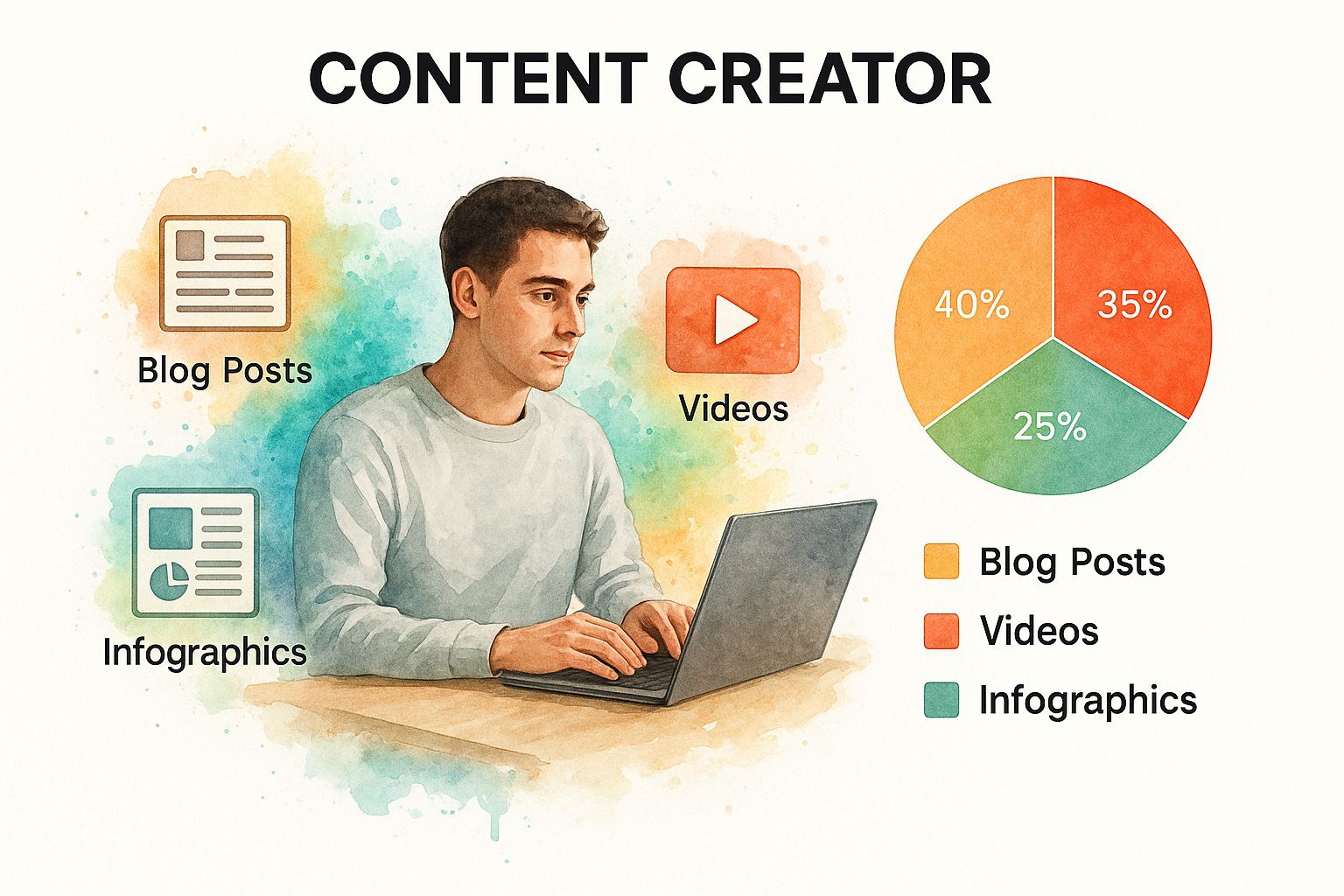
As you can see, a winning strategy often uses a mix of channels, with every piece of content perfectly tuned for its platform and the audience you'll find there.
Building Audiences and Demand on Meta Platforms
While Google is fantastic for capturing existing demand, Meta's platforms—Facebook and Instagram—are where you go to create it. Here, you can get in front of people based on incredibly detailed demographics, interests, and behaviors, even if your service isn't top of mind.
The targeting is incredibly granular. A real estate agent could build an audience of people who recently got engaged, follow Zillow, and live within a 20-mile radius of a desirable suburb. This allows you to introduce your brand to a highly relevant audience long before they begin their official home search.
Expert Tip: Lookalike Audiences on Meta are a powerful tool. You can upload a list of your best customers, and the platform will find new people who share similar traits. It's one of the fastest ways to improve your targeting efficiency.
Because users on these platforms are in a more passive, discovery-focused mindset, your approach must match. A hard sell will fall flat. Instead, lead with value:
- Offer a helpful download (e.g., "The First-Time Homebuyer's Checklist").
- Invite them to a free webinar.
- Showcase a video tour of a stunning property.
This approach builds brand awareness and gently nurtures potential leads, keeping your sales funnel full.
Dominating B2B Lead Generation with LinkedIn
For B2B businesses, LinkedIn is in a league of its own. It's the digital hub for professionals—the place where decision-makers consume industry news, network, and vet potential vendors.
This professional context makes it the perfect hunting ground for high-value B2B leads. A SaaS company selling project management software can target users by their exact job title ("Project Manager"), company size, and industry. That precision ensures your message lands directly in front of the people who control the budget.
Data shows that 40% of B2B marketers view LinkedIn as their top channel for high-quality leads. Its native Lead Gen Forms are especially effective, with an average conversion rate of 13%—over five times higher than what you might see on a typical landing page.
Lead Generation Channel Comparison
To help you decide where to start, here’s a quick breakdown of the major channels and their strengths.
| Channel | Best For | Audience Type | Primary Strength |
|---|---|---|---|
| Google Ads | Capturing immediate, urgent demand; local services | Problem-aware, actively searching | High-intent targeting |
| Meta (Facebook/Instagram) | Creating demand; brand awareness; visual products/services | Passive, discovery-focused | Granular demographic & interest targeting |
| LinkedIn Ads | High-value B2B services; reaching decision-makers | Professional, career-focused | Precise job title & company targeting |
Choosing the right channel mix is a strategic decision rooted in your ICP and business goals. When you understand the unique strengths of each platform, you can invest your budget wisely and build a powerful, multi-channel machine to generate leads online consistently.
Crafting Irresistible Offers and High-Converting Landing Pages

You did it. You selected the right channel, perfected the targeting, and your ideal customer saw your ad. They were interested enough to click.
That click, however, is only half the battle. If that click leads to a clunky, confusing, or uninspired page, you've just wasted your ad budget. The journey from initial click to lead submission must be a seamless handoff where your prospect feels they are receiving immense value.
This is where your offer (the lead magnet) and your landing page must shine. A great ad leading to a poor landing page is like an amazing movie trailer for a terrible film—it gets people in the door, but the disappointment ensures they never become fans.
The Psychology of a Powerful Lead Magnet
A lead magnet is simply a valuable resource you offer for free in exchange for contact information. The key word is valuable. It must solve an immediate problem or satisfy a burning curiosity for your ideal customer.
Here are a few real-world examples that work time and again:
- For a Realtor: A "Free Instant Home Valuation" directly targets homeowners curious about their property's current market value, offering personalized, high-value information.
- For a Local Contractor: Offering a "Complimentary Project Quote" or a "Free 15-Minute Consultation" removes the friction and uncertainty for someone considering a renovation.
- For a Financial Advisor: A guide like "The 5 Biggest Retirement Mistakes to Avoid" taps directly into the core anxieties of their target clients and immediately positions the advisor as a trusted expert.
The best lead magnets deliver an instant win or a clear path forward. They are sharp, targeted tools designed to attract exactly the right kind of prospect.
Anatomy of a High-Converting Landing Page
Once you have an irresistible offer, you need a dedicated page to present it. A great landing page has one job: to get the visitor to convert. Unlike your homepage, which is filled with distracting links, a landing page is a clean, direct, and persuasive pitch for your offer.
Every element on the page must work in harmony to build trust and guide the user toward the form.
We’ve seen it happen: a landing page with multiple offers or navigation links can decrease conversion rates by up to 26%. The power is in its singular focus. Your job is to remove every possible distraction and steer the user toward the one action you want them to take.
Essential Landing Page Components
To turn clicks into qualified leads, your landing page must include these elements:
- A Punchy Headline and Sub-headline: This is the first thing people read. It must instantly confirm they are in the right place and spell out the benefit. For example: "Get Your Accurate Boca Raton Home Value in 60 Seconds."
- Persuasive, Scannable Copy: No one reads a wall of text. Use short paragraphs and bullet points to highlight the key benefits. Answer the visitor’s core questions: What is this? Why should I care? What do I get?
- Compelling Visuals: A high-quality image or a short, relevant video makes a huge difference. If you're a roofer, show a clean, sturdy roof you installed, not a generic stock photo.
- Social Proof and Trust Signals: This is non-negotiable for building credibility. Include customer testimonials, Google reviews, client logos, or industry awards to show that others have trusted you and were happy with the results.
- A Frictionless Form: Keep it simple. Only ask for the information you absolutely need for the first step, such as a name and email. Every extra field is another reason for someone to abandon the form.
- A Clear Call-to-Action (CTA): The button text matters. Instead of a generic "Submit," try something action-oriented like "Get My Free Valuation Now" or "Download My Free Guide." Make the button stand out with a contrasting color.
For businesses looking to scale, managing landing pages and follow-up sequences can become complex. An integrated system, like our Adfuel+ CRM integration, can automate this entire flow, ensuring every lead from your high-converting page is captured and nurtured effectively.
Your Top Online Lead Generation Questions, Answered
Jumping into online advertising can feel like a high-stakes game, especially when your own money is on the line. Getting clear, no-nonsense answers is the first step toward building a confident, growth-oriented strategy.
We hear these questions all the time from realtors, local service providers, and marketing managers. Our goal is to cut through the jargon and provide practical advice you can use immediately.
How Much Should I Budget for Online Lead Generation?
This is the big one, but there’s no single magic number. The right budget depends entirely on your industry, location, and the level of competition.
Instead of guessing, work backward from your goals. The key is to first determine your target Cost Per Lead (CPL).
For example, a real estate brokerage knows a new client could generate $10,000 in commission. In that context, spending $200 to acquire that client's information is an excellent investment. On the other hand, a plumber might aim for a CPL closer to $30-$50, based on the value of a typical service call.
A solid starting point for most small businesses is a test budget of $500 to $1,000 per month. This is typically enough to gather initial performance data from platforms like Google or Meta. Once you can prove profitability and see a positive Return on Ad Spend (ROAS), you can scale up with confidence. The focus should always be on profitability, not just spending.
What Is a Good Landing Page Conversion Rate?
While you'll often see benchmarks of 2-5%, this figure can be misleading. A "good" conversion rate is entirely relative to your industry, offer, and traffic source.
A highly specific offer like a "Free Roof Inspection for Hail Damage" will naturally convert better than a generic "Contact Us" page.
Instead of obsessing over a universal number, adopt a mindset of continuous improvement. Your primary goal should be to consistently beat your own previous record.
Here’s a simple process:
- Set Your Baseline: Let your landing page run for a few weeks to establish its initial performance.
- A/B Test One Element: Change just one thing, such as the headline, the call-to-action button color, or the main image.
- Implement the Winner: Once a clear winner emerges from your test, make it the new default version of your page.
- Repeat: Pick another element to test and start the process again.
This methodical approach is how you can transform a standard landing page into a high-performer that achieves 10% conversion rates or even higher.
How Long Until I See Results from My Campaigns?
With paid advertising platforms like Google and Meta, you can see traffic and even a few leads within 24-48 hours of launching a campaign. However, seeing initial interest is different from establishing a stable, predictable, and profitable flow of new customers.
You should plan for an initial "data gathering" phase of at least 30 to 90 days. This period is critical for several reasons:
- It allows the platform's algorithm time to learn who your ideal customer is and optimize ad delivery.
- It provides you with enough performance data to make informed decisions.
- It gives you the runway to A/B test your ads and landing pages to find the winning combination.
Patience is key. The true power of online lead generation comes from refining your strategy with real-world data, not from a single, short-lived campaign.
Should I Use Gated Content to Generate Leads?
"Gating" your content—requiring contact information for access—is an excellent tactic when used for the right assets. The secret is ensuring a fair value exchange. If you are asking for their valuable contact information, you must provide something equally valuable in return.
High-value assets are perfect for gating, such as:
- In-depth ebooks or industry guides
- Recordings of exclusive webinars
- Helpful tools or free calculators
- Detailed case studies with real data
However, avoid gating everything, as this can hinder your SEO and limit your brand's reach. A balanced strategy is most effective. Use free content like blog posts to attract a broad audience and build initial trust. Then, use your premium, gated content to convert the most interested visitors into qualified leads. This one-two punch builds both your brand and your sales pipeline.
Ready to stop guessing and start building a predictable pipeline of high-quality prospects? Let Digital Advertising Direct create and manage a powerful, data-driven lead generation system for your business.