
To truly succeed at generating insurance leads, you need more than just a slick ad. It’s about building a system that combines a solid game plan, smart digital advertising, and a follow-up process that converts prospects into policyholders. This means getting crystal clear on your ideal client, understanding what your competitors are doing, and then launching focused campaigns on platforms like Google and Facebook where your prospects are already spending their time.
The goal isn't just to find leads; it's to build a predictable, scalable machine that brings in high-quality opportunities like clockwork.
Building Your Foundation for High-Quality Leads
Before you invest a single dollar into an ad platform, you must lay the proper groundwork. This is the unglamorous but absolutely essential work that separates a campaign that burns cash from one that builds a profitable book of business.
It all starts by abandoning the vague idea of selling to "anyone who needs insurance." That's a recipe for generic messaging, ineffective targeting, and unnecessarily high lead costs. To win, you have to get specific.
Define Your Ideal Client Profile
You don't sell "insurance"; you sell specific solutions to specific problems. A smart strategy means creating distinct personas for each major product you want to promote. This exercise turns faceless demographics into real people, which makes your marketing infinitely more powerful.
Consider the difference between these two potential clients:
- Term Life Insurance Client: Let's call her "Sarah." She's 35, a new parent living in the suburbs. Her primary concern is ensuring her family's financial security if the unthinkable happens. She’s looking for a solution that is affordable, easy to understand, and quick to implement. Her pain point is the fear of leaving her family exposed, coupled with confusion about policy jargon.
- Final Expense Insurance Client: Now meet "David." He’s 62, preparing for retirement, and perhaps downsizing his home. His focus is entirely different. He wants to ensure his final expenses don't become a burden for his children. He values a trustworthy local agent he can talk to and a policy with a fixed premium.
With these detailed profiles, you can write ad copy and design landing pages that speak directly to Sarah’s anxieties or David’s motivations. It’s a complete game-changer for your results.
Perform a Sharp Competitive Analysis
Once you know who you're targeting, you need to see who else is trying to get their attention. A competitive analysis isn't about copying what others are doing; it's about finding gaps in the market and identifying where you can win. Start by searching for your key services in your local area and analyze the top 3-5 agents or agencies that appear.
By looking at what your most successful competitors are doing, you can reverse-engineer their playbook. You're looking for holes in their messaging, audiences they might be ignoring, or promises you can deliver on better than they can.
As you analyze their strategy, make note of a few key things:
- Their Core Message: What is their primary promise? Speed? Price? White-glove service? Unmatched expertise?
- The Offers They Promote: Are they all pushing "free quotes"? Or perhaps a "free policy review" or an educational guide? This reveals what they believe resonates with the audience.
- Channels They Use: Are they all-in on Google Ads? Highly active on Facebook? Or winning with local SEO? This shows you where they are investing their marketing budget.
Set Clear and Realistic KPIs
You can't determine if you're winning if you haven't defined the score. Key Performance Indicators (KPIs) are the specific metrics that tell you if you're achieving your business goals. Without them, you're operating blindly and hoping for the best.
Get started with these three essentials:
- Cost Per Lead (CPL): The simple formula: total ad spend divided by the number of leads generated. This tells you exactly what it costs to get one person to express interest.
- Conversion Rate: The percentage of visitors who land on your page and complete the desired action (e.g., fill out your form). A low number here almost always indicates a problem with the page or the offer itself.
- Customer Acquisition Cost (CAC): This is the ultimate metric. It’s the total cost of marketing and sales required to acquire one new paying client. This number determines whether your marketing efforts are truly profitable.
Setting realistic targets for these KPIs—such as aiming for a $45 CPL or a 5% landing page conversion rate—gives you a benchmark to measure performance. This foundational work ensures every dollar you spend is tracked, measured, and working to build your business from day one.
How to Generate Insurance Leads with Google Ads

While channels like Facebook are great for creating demand, Google Ads is where you capture it. This is your direct line to prospects at the exact moment they’re actively searching for insurance solutions. They aren't just scrolling; they are on a mission to find an answer, and often, a quote.
Mastering how to generate insurance leads with Google Ads means looking beyond obvious, high-cost keywords like "car insurance." The real value lies in targeting prospects who are much closer to making a purchasing decision.
Master Long-Tail Keywords for Higher Intent
Long-tail keywords are the secret sauce of successful search campaigns. These are longer, more specific phrases that people type into Google. While they have lower search volume, their conversion rates are significantly higher because the searcher's intent is crystal clear.
Consider the difference in mindset. One person searches for "auto insurance." Another searches for "best auto insurance for safe drivers over 50." Who do you think is more ready to buy? The second person knows exactly what they need and is much further down the path to making a decision.
Your keyword strategy should pivot to these ultra-specific queries:
- Instead of "life insurance," target "term life insurance for new parents under 40."
- Instead of "home insurance," bid on "compare homeowners insurance quotes in Boca Raton."
- Instead of "business insurance," focus on "liability insurance for a new LLC."
This approach does more than just bring in better leads. It helps you sidestep the fierce bidding wars against national carriers and their massive budgets.
Structure Ad Groups for Maximum Relevance
A common mistake agents make is dumping all their keywords into one giant ad group. This practice tanks your Quality Score—Google's rating of how relevant your keywords, ads, and landing page are to each other. A low Quality Score means you pay more for every click and your ads show up less often.
The solution is to build tightly-themed ad groups, organized by policy type or a specific client need. For example, a life insurance campaign should be structured like this:
Campaign: Life Insurance
- Ad Group 1: Term Life Insurance
- Keywords: "30-year term life insurance," "affordable term life policy," "get a term life quote."
- Ads: Write copy that speaks directly to the affordability and temporary coverage of term life.
- Ad Group 2: Whole Life Insurance
- Keywords: "whole life insurance cash value," "permanent life insurance for seniors."
- Ads: Craft copy that highlights the investment benefits and lifelong protection.
This tight structure ensures your ad is a perfect match for the user's search query. This boosts your Quality Score, which lowers your Cost Per Click (CPC) and can improve your ad's position on the page.
When your keywords, ad copy, and landing page are all aligned, you create a seamless and highly relevant user experience. Google recognizes this and rewards you with better performance and lower costs.
Write Ad Copy That Solves a Problem
Your ad has one job: convince the searcher that you have the immediate solution to their problem. This is not the place for industry jargon or a boring list of features. You need to focus on benefits and tap into real emotions—security, savings, and peace of mind.
A powerful headline like "Protect Your Family for $1/Day" is infinitely more effective than "Affordable Life Insurance Plans." The first is specific, tangible, and strikes an emotional chord.
Your description should then reinforce that promise and provide a clear, compelling call-to-action (CTA).
Example of Effective Ad Copy:
- Headline: Secure Your Family's Future
- Description: Fast, Affordable Term Life Quotes. Policies Starting at $27/Month. Protect Your Loved Ones Today. Get Your Free Quote Online in 2 Minutes.
This copy is direct and effective. It highlights affordability and offers a clear, low-friction next step. For more ideas on writing compelling content, exploring different marketing strategies on our Digital Advertising Direct blog can provide valuable insights.
Maximize Visibility with Ad Extensions
Think of Ad Extensions as free upgrades for your ads. They are extra snippets of information that make your ad larger and give users more reasons to click. They cost nothing extra to use and can have a massive impact on your click-through rate (CTR).
For insurance agents, these are the must-haves:
- Sitelink Extensions: Add direct links to other important pages on your site, like "About Us," "Types of Coverage," or "Contact Us."
- Call Extensions: Place your phone number directly in the ad, a game-changer for mobile searchers who prefer to call.
- Location Extensions: Display your office address and a map, building immediate trust with local searchers.
- Callout Extensions: Highlight key selling points like "24/7 Claims Support," "No Medical Exam," or "A+ Rated Carrier."
Using these extensions makes your ad physically larger on the search results page, pushing competitors down and making your agency the obvious, most helpful choice.
Creating Demand with Strategic Facebook Ads

While Google Ads is excellent for capturing people already looking for insurance, Facebook (now Meta) is where you create future clients. The strategy here is to get your agency in front of the right people before they even begin their search. You proactively build demand by appearing in the feeds of highly relevant audiences who fit your ideal client profile.
The competition for attention is fierce. The U.S. insurance industry is a digital advertising juggernaut, spending $11.7 billion in 2021 with forecasts hitting $12.51 billion. This isn't just a number; it's a testament to how crowded the space is. This in-depth analysis of lead generation strategies shows just how much is being invested.
But here’s the good news. Your advantage isn't in outspending the giants—it's in out-targeting them with smarter, more personalized campaigns.
Target Audiences Based on Life Events
One of the most powerful tools in Meta's arsenal for insurance agents is life event targeting. This feature lets you put your ads directly in front of people at the precise moments their insurance needs are fundamentally changing. You become a timely solution to a problem they are just beginning to consider.
Instead of casting a wide, generic net, zero in on these critical life moments:
- Recently Married or Engaged: The perfect time to discuss joint life insurance policies or bundling auto and home for savings.
- New Homeowners: A golden opportunity to offer homeowners insurance, mortgage protection, and umbrella policies.
- Expecting Parents or Parents with Newborns: Nothing triggers a life insurance conversation faster than the arrival of a new baby.
- Recently Moved: A prime window to offer new renters or homeowners policies.
When you target these events, your ad feels less like a random interruption and more like a genuinely helpful suggestion at exactly the right time.
Build Powerful Lookalike Audiences
The fastest way to find new clients is to find more people who look exactly like your current best clients. That’s precisely what Lookalike Audiences are designed for. You can upload a customer list (like email addresses or phone numbers), and Facebook’s algorithm will analyze their common traits to build a much larger audience of new users with similar characteristics.
Lookalike Audiences are your fast track to high-value prospects. You're not guessing who to target; you're using real data from your most successful clients to guide Meta's algorithm.
This is a cornerstone strategy for anyone serious about how to generate insurance leads on social media. The key is to start with a high-quality source list of at least 100 of your best clients. This gives the algorithm enough data to find strong matches and almost always delivers a lower Cost Per Lead than targeting cold interests alone.
Craft Ad Creative That Builds Trust and Simplifies Action
On a platform like Facebook, your ad has to do two things instantly: stop the scroll and build a connection. Bland, corporate-style ads are invisible. You need creative that feels human and makes the next step incredibly easy.
Here are a few proven creative strategies for insurance:
- Video Testimonials: A short, authentic video of a happy client is more persuasive than any ad copy. It provides instant social proof and builds trust.
- Lead-Gen Forms: Use Meta’s built-in lead forms. When someone clicks your ad, a form pops up that’s pre-filled with their Facebook profile info (name, email, phone). This slashes friction and can send conversion rates soaring.
- Problem-Solution Visuals: Use a simple graphic or a quick video to highlight a common pain point (e.g., "Worried about your mortgage?") and immediately present your product as the clear, simple solution.
For example, a local agent in Tampa could run a video ad featuring a client talking about their smooth claims process after a hurricane. The ad targets homeowners in specific zip codes and uses a lead-gen form with a CTA like, "Get Your Free Hurricane Prep & Insurance Review." That’s how you combine powerful creative with surgical targeting to build a campaign that converts.
Designing Landing Pages That Convert Traffic
Getting targeted traffic to your website is a huge win, but it’s only half the battle. A click without a conversion is a wasted ad dollar. The real challenge—and where most agents leak potential revenue—is turning that click into a qualified lead. This is where a meticulously designed landing page becomes your most valuable asset.
This process is critical for any agent trying to figure out how to generate insurance leads effectively. A landing page isn't your homepage; it's a specialized, single-purpose page built to convert visitors from a specific ad campaign. Its sole purpose is to get a user to take one specific action, like requesting a free quote.
The Anatomy of a High-Converting Page
Every element on your landing page must work together to build trust and guide the visitor toward your call-to-action. There is no room for distractions, confusing navigation, or mixed messages.
Think of it this way: your ad makes a promise, and your landing page must instantly deliver on it. If your Google Ad promises "Fast Quotes for Term Life Insurance," your landing page headline must echo that sentiment, with something like "Get Your Free Term Life Insurance Quote in Under 2 Minutes." This immediate message match confirms to the visitor they're in the right place.
A great landing page is focused and frictionless. It answers the visitor's unspoken questions: "Am I in the right place? Do you understand my problem? Can I trust you? Is this worth my time?"
Effective pages combine compelling copy with strategic design to create a seamless user experience that encourages action.
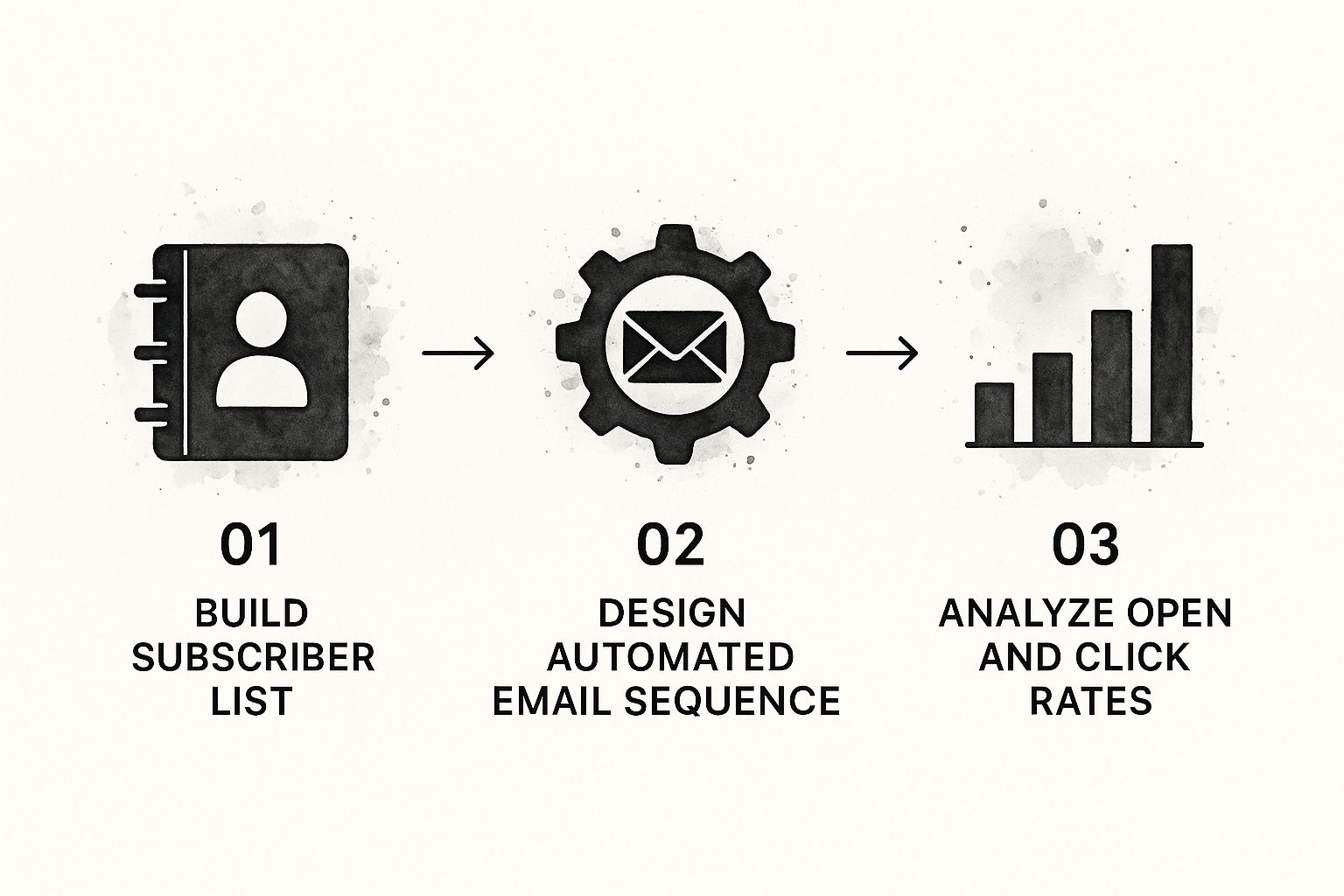
This visual shows the flow from capturing to nurturing the leads your landing page generates. To build a page that consistently performs, you need to nail these essential components.
| Anatomy of a High-Converting Insurance Landing Page |
| :— | :— |
| Element | Purpose & Best Practice |
| Compelling Headline | Instantly grab attention and confirm the visitor is in the right place. It must match the ad's promise. |
| Benefit-Driven Copy | Focus on what the prospect gets, not just what you offer. Address their pain points and solve their problems. |
| Strong Trust Signals | Build credibility fast with testimonials, carrier logos, awards, or A+ ratings. People need to trust you with their information. |
| A Single, Clear CTA | Tell the visitor exactly what to do next. Use action-oriented text on a contrasting button. No other distracting links! |
| Simple, Short Form | Only ask for essential information. The easier it is to complete, the higher your conversion rate will be. |
| Social Proof | Show that others have chosen you and are happy. Client reviews or case studies are incredibly powerful. |
By ensuring each of these elements is in place and optimized, you create a frictionless path from click to lead.
Systematically Improve with A/B Testing
Your first landing page draft will likely not be your best one. The most successful marketers know that continuous improvement through A/B testing (or split testing) is how you systematically increase your conversion rate over time. The process is simple: you create two versions of your page (Version A and Version B) with one key difference, show each to a portion of your audience, and see which one performs better.
Start by testing high-impact elements first:
- Headlines: Test a benefit-focused headline against a question-based one.
- CTA Button Copy: Does "Get Your Quote" outperform "See My Price"? Only testing will tell you for sure.
- Form Length: Test a short form (name, email, phone) against a longer one that asks more qualifying questions. You might get fewer leads with the longer form, but their quality could be much higher.
By consistently testing and implementing the winning variations, you can significantly increase your conversion rate over time, ensuring your ad spend delivers the highest possible ROI. For agencies that prefer expert assistance, fully managed solutions like Ad-Fuel Plus can build and optimize these high-performance assets for you.
Automating Your Follow-Up with a Smart CRM

All the hard work of generating traffic and converting clicks can go to waste if your follow-up process is weak. In the insurance industry, speed and consistency are everything. A lead who waits hours—or even minutes—for a response is a lead who is already on the phone with your competition.
This is where automation becomes your secret weapon. A smart Customer Relationship Management (CRM) system acts as the command center for your entire lead generation machine, ensuring no prospect falls through the cracks. It's the only way to scale your outreach without scaling your workload.
Your CRM as the Central Hub
Think of your CRM as the brain of your sales operation. It is designed to instantly capture leads from all your channels—Google Ads, Facebook lead forms, landing pages—and pull them into one organized, actionable dashboard.
The moment a prospect hits "submit," their information is logged. This eliminates manual data entry, prevents costly errors, and, most importantly, triggers an immediate response.
The single biggest factor separating top-earning agents from the rest is often speed-to-lead. A CRM doesn't just store contacts; it triggers an immediate, automated response sequence that engages leads while their interest is at its absolute peak.
This instant engagement is the first step in building a relationship and dramatically boosts your chances of being the first agent they speak with.
Designing an Automated Nurture Sequence
Once a lead enters your CRM, the real work begins. A well-designed nurture sequence using a combination of email and SMS can guide a prospect from mild curiosity to a booked appointment—all on autopilot.
A typical sequence for a new insurance lead could look like this:
- Immediate Welcome (Within 2 minutes): An automated text and email fire off instantly. The SMS should be casual: "Hi [First Name], thanks for your interest in a [Policy Type] quote. I'm reviewing it now and will call you shortly from this number. -[Your Name], [Your Agency]." The email confirms their request and introduces you more formally.
- Educational Content (Day 2): Send a follow-up email that provides value, not just a sales pitch. This could be a link to a blog post like "5 Mistakes to Avoid When Buying Life Insurance."
- Social Proof (Day 4): Share a client testimonial or case study. An email with a subject like, "See how we helped a local family save 20% on their auto insurance," can be incredibly powerful.
- Direct Call-to-Action (Day 7): If they still haven't converted, the final automated message makes a clear ask. "Hi [First Name], ready to discuss your options? You can book a free 15-minute consultation directly on my calendar here."
This structured approach keeps you top-of-mind without requiring manual tracking of every interaction.
Segmenting Leads for Personalized Communication
Not all leads are created equal. A great CRM allows you to segment prospects based on their behavior and the information they've provided. This is essential for closing more deals.
You can build different lists and trigger different automation sequences based on specific criteria.
Common Segmentation Strategies
- By Policy Interest: Separate leads interested in auto, home, life, or business insurance. Each group requires content tailored to their specific needs.
- By Lead Source: A lead from a Google search for "final expense insurance" has different motivations than one from a Facebook ad targeting new homeowners. Knowing this allows you to personalize your outreach.
- By Engagement Level: Your CRM can track who opens your emails or clicks your links. Create a "hot leads" list for those who are highly engaged and prioritize them for a personal phone call.
This level of personalization demonstrates that you understand their specific situation, which is key to building the trust needed to earn their business.
Got Questions About Insurance Lead Generation? We've Got Answers.
Even with a solid plan, you're likely to encounter questions as you learn how to generate insurance leads that convert. Here are straight-to-the-point answers to some of the most common questions we hear from agents.
How Much Should an Insurance Agent Spend on Leads?
There is no one-size-fits-all answer. Your ideal marketing budget is tied to your agency's goals, location, and the products you sell. As a general rule, a good starting point is to allocate 10-15% of your desired commission earnings for marketing.
The most critical advice is to start with a manageable budget, track your Cost Per Lead (CPL) and Customer Acquisition Cost (CAC) meticulously, and only scale up once you have a profitable and predictable system in place.
What Is a Good Conversion Rate for Insurance Landing Pages?
Conversion rates vary based on traffic source and the quality of your offer. However, a solid industry benchmark to aim for is a 3-5% conversion rate for your landing pages.
That said, highly-optimized, niche campaigns—like "final expense insurance for seniors in Miami"—can achieve conversion rates of 10% or higher. Your focus should be on continuous improvement. A/B testing headlines, calls-to-action, and trust signals is the only surefire way to push your conversion rate higher over time.
Is It Better to Buy Leads or Generate My Own?
This is a classic dilemma. Buying leads provides immediate volume, but the leads are almost always sold to multiple other agents. This means you're competing for attention, and lead quality can be inconsistent.
Generating your own leads through channels like Google and Facebook Ads requires more upfront effort and investment. However, the reward is significant: you get exclusive, high-intent prospects who have already engaged with your brand and are far more likely to convert into clients. For long-term, sustainable growth, building your own lead generation engine is the winning strategy.
How Quickly Do I Need to Follow Up with a New Lead?
You need to be fast—instantly fast. Data shows that you should make contact within five minutes of receiving a lead. The probability of qualifying a prospect drops dramatically with every minute that passes.
This is why an automated CRM is not a "nice-to-have"; it's a necessity. A system that can send a personalized text or email the second a lead comes in is what separates agents who close deals from those who miss opportunities.
Ready to stop chasing cold leads and start attracting high-intent clients? Digital Advertising Direct builds and manages custom ad campaigns that deliver a steady stream of exclusive prospects directly to your pipeline. Get a free strategy session today and discover how we can fuel your agency's growth.