
As a local business owner, getting seen and heard in a crowded market can feel like an uphill battle. But what if you had a direct line to potential customers in your own neighborhood? This is where Facebook ads for local businesses become your most powerful tool. It's not about competing with national brands; it's about transforming a modest ad spend into real foot traffic, qualified leads, and measurable growth.
Why Facebook Ads Are a Game-Changer for Your Local Market
Feeling like you're shouting into the digital void? You're not alone. The power of Facebook advertising isn't just its massive user base; it’s the platform's incredible ability to laser-focus your message to the people who live and work right in your backyard. This isn't about hitting the "Boost Post" button and hoping for the best. It's about smart, hyper-local targeting that puts your business in front of your ideal customers.
Think of it this way: a local realtor in Boca Raton could run ads that only show up for renters in specific apartment buildings who have also shown interest in buying a home. A pizzeria in Austin could run a lunch special ad that appears only on the phones of people working within a one-mile radius, right between 11 AM and 1 PM. This level of precision, once reserved for corporate budgets, is now at your fingertips.
Key Insight: The true value of Facebook ads for local businesses lies in its sophisticated geo-targeting. The platform’s ability to narrow its massive reach down to a single street, neighborhood, or ZIP code makes every ad dollar work smarter and harder for you.
The data confirms this. With over 3 billion monthly active users, a significant portion of your local community is on the platform, ready to be engaged. This geo-targeting makes it possible to drive actual in-store visits and establish your brand as a local leader. Even with smaller budgets, local businesses often see impressive results, with average ad conversion rates hovering around 9.2%. You can dig into more data on how small businesses are performing to see what's possible.
The Core Benefits for Your Business
This direct connection to your local audience delivers tangible benefits that directly impact your bottom line:
- Drive Foot Traffic: Use location-based ads to pull nearby customers through your door. Compelling offers like "show this ad for 10% off" create immediate action and turn scrollers into shoppers.
- Generate Qualified Leads: Capture contact information from people in your service area who are actively looking for your solutions—whether it's a quote for a home repair or a consultation for real estate services.
- Build a Local Community: Go beyond one-off sales. Engage with residents, promote local events, and position yourself as the go-to expert in your field. This is how you build the trust and loyalty that drives long-term success.
Defining Your Local Audience and Crafting Your Offer
Before you spend a single dollar, your success with Facebook ads for local businesses hinges on two things: knowing exactly who you're talking to and what irresistible offer you're putting in front of them. Generic marketing gets ignored; targeted, value-driven campaigns win.
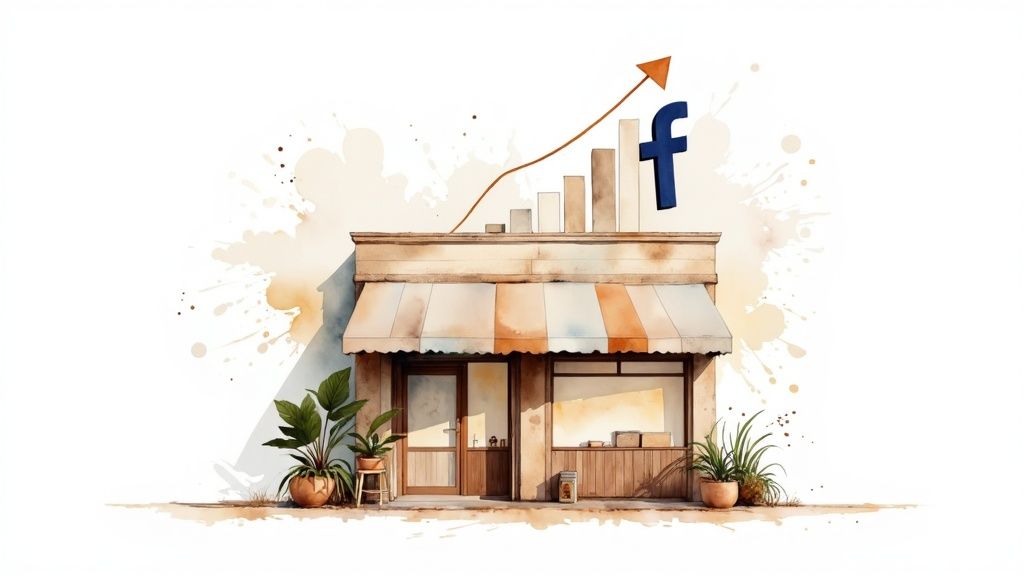
This process starts with creating a detailed Ideal Customer Profile (ICP). An ICP isn't just "homeowners in my city." It’s a granular, humanized picture of the person most likely to become a loyal customer.
From Broad Strokes to a Sharp Portrait
Think like a detective. A local chiropractor isn’t just targeting "people with back pain." A smarter campaign might focus on office workers aged 30-50 who live within a 5-mile radius and have shown interest in "ergonomic chairs" or "corporate wellness." The difference is monumental.
Let's walk through a real-world example. A realtor in Boca Raton, Florida, wants to find clients looking to downsize. A sharp ICP would look like this:
- Demographics: Ages 58-70, homeowners in specific affluent ZIP codes (e.g., 33431 or 33432), with a household income over $150k.
- Life Events: Empty-nesters, recently retired, or individuals nearing retirement.
- Interests: Luxury travel, local golf clubs, financial planning pages, and high-end condo association groups on Facebook.
This level of detail transforms your ad from a noisy billboard into a timely, personal recommendation.
Crafting an Irresistible Local Offer
Once you've identified who you're targeting, you need to determine what will make them stop scrolling and take action. A great local offer is specific, valuable, and has a touch of urgency. It must solve an immediate problem for the community you serve.
Passive calls to action like "Call Us Today" or "Learn More" are ineffective. You need an offer that feels too good to pass up.
Here’s how to reframe a weak offer into a powerful one:
- For a Home Service Pro: Instead of "Get a Quote," try: "Claim Your Free Gutter Cleaning Inspection for Homes in the 90210 ZIP Code – Offer Ends Friday!"
- For a Restaurant: "Check Out Our Menu" is boring. Instead, use: "Show This Ad for a Free Appetizer with Any Entrée Purchase This Week Only."
- For a Real Estate Agent: "Thinking of Selling?" is weak. A stronger offer is: "Get a Free, No-Obligation Home Valuation for Palm Beach County Residents – Delivered in 48 Hours."
The goal is to make the decision to click a no-brainer. You're offering tangible value in exchange for their attention. For more strategic inspiration, explore the different marketing approaches on our Digital Advertising Direct blog.
How to Set Up High-Performing Facebook Ads for Local Businesses
You've done your homework, you know your ideal customer, and you have an offer they can't refuse. Now it's time to jump into Meta Ads Manager and bring your campaign to life. The choices you make here will directly influence your budget's efficiency and the quality of leads you generate.
The first, and most important, decision is your campaign objective. This tells Facebook's algorithm your goal, and it will optimize everything to achieve it.
Choosing the Right Campaign Objective
Think of the objective as your campaign's North Star. For local businesses, this typically comes down to a few core choices.
Local Ad Campaign Objective Comparison
| Campaign Objective | Best For Local Businesses When… | Key Metric to Track |
|---|---|---|
| Leads | You need to collect contact info (names, emails, phones) for follow-up. Perfect for service providers like roofers, dentists, or realtors. | Cost Per Lead (CPL) |
| Engagement | You want to create local buzz, promote an event, or get social proof on a post about a new menu item or special offer. | Cost Per Engagement |
| Traffic | Your goal is to get people to visit a specific page on your website, like a detailed service page, a menu, or a blog post. | Cost Per Click (CPC) |
| Sales | You have an online booking or ordering system and want to drive direct appointments or purchases on your website. | Return On Ad Spend (ROAS) |
Each objective serves a different purpose, but one stands out for most local businesses looking for growth.
For most local businesses trying to get the phone to ring and the inbox to fill up, we strongly recommend starting with the "Leads" objective. It's the most direct and measurable path from ad spend to actual revenue opportunities.
Mastering Local Targeting Precision
This is the superpower of Facebook ads for local businesses. The ability to zero in on a specific geographic area prevents you from wasting money on people who couldn't hire you even if they wanted to.
You can start by dropping a pin on your business address. A local coffee shop might only need a tight 1-mile radius. A roofer, however, might expand that to a 20-mile radius to cover their entire service area.
But you can get even more sophisticated:
- Target specific ZIP codes where you know your best customers live.
- Cover entire cities or counties for a broader approach.
- Exclude areas to refine your targeting. A high-end landscaper, for example, could target an affluent county but exclude a few lower-income ZIP codes.
This infographic breaks down the layering process for finding your perfect local audience.
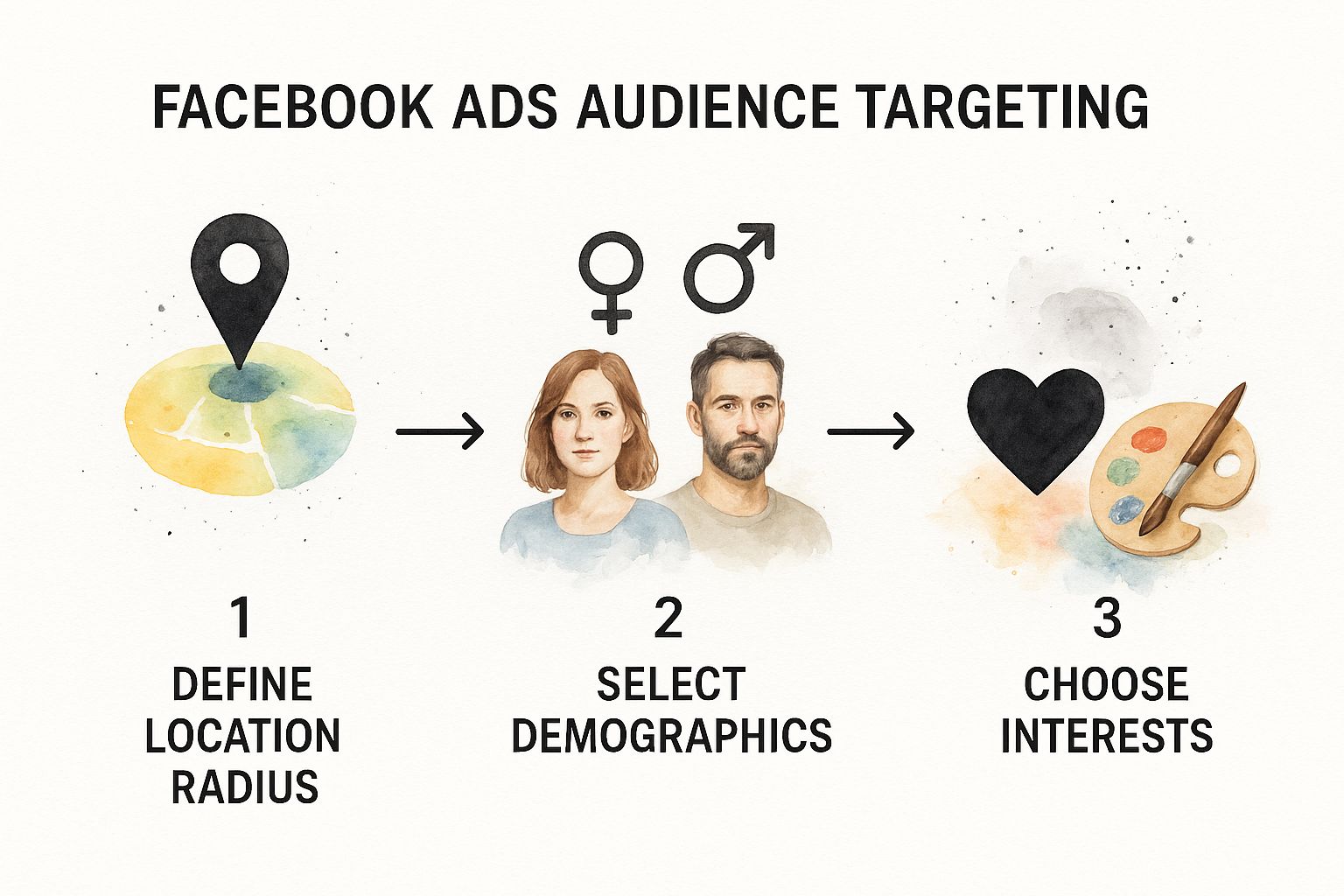
It's a funnel: start broad with your location, then narrow it down with the demographic and interest details from your customer profile. This combination of location + interests is what makes these campaigns so effective.
Deciding on Ad Placements
The final piece of the setup is deciding where on Meta's network your ads will appear. You have two main options: Advantage+ Placements and Manual Placements.
Advantage+ Placements is the automated option. It lets Meta's algorithm show your ads everywhere—Facebook Feed, Instagram Reels, Messenger, etc.—and automatically optimizes for the best-performing spots. This is a great starting point.
However, Manual Placements offer more control. If you know your audience primarily uses Instagram Stories, you can focus your budget only there. For those who want expert oversight without the guesswork, a managed solution like our Adfuel+ program ensures your ads are always in the right place.
Start with Advantage+ Placements. After a week, analyze your reports. If one placement (like Facebook Feed) is outperforming the others, you can switch to Manual Placements to double down on what works.
Designing Ad Creative That Stops the Scroll
You’ve structured your campaign and dialed in your audience. Now comes the part your customers will actually see. In a fast-scrolling feed, your ad creative is your one shot to grab attention and make a connection.
The classic mistake is using generic stock photos. A picture of a random person smiling at a laptop builds zero trust. A real photo of your team in front of your branded truck or your recognizable storefront, however, builds instant local credibility.
Embracing Authenticity in Your Visuals
Your creative needs to look like it belongs in your community. People can spot stock imagery instantly, and it signals that you're either not truly local or not putting in the effort.
Here’s what works for local businesses:
- Real People, Real Places: Ditch the models. Show your actual employees, your office, or your work vehicle. A picture of your roofing crew on a real roof in a local suburb is infinitely more powerful than a stock photo of a hammer.
- Before-and-After Shots: This format is gold for home services, landscapers, and auto detailers. It visually communicates the value you provide in the most compelling way possible.
- Showcase Your Product in a Local Setting: A bakery can show its cupcakes at a well-known local park. A realtor can feature a home with a familiar landmark in the background. It creates an immediate "I know that place!" connection.
Key Takeaway: Authenticity isn't about polish; it's about being real. A slightly imperfect, real-world photo from your phone will almost always outperform a slick, impersonal stock image.
Writing Copy That Speaks to Your Neighbors
Your ad copy is your direct conversation with a potential customer. It must be clear, direct, and speak their language by referencing local touchpoints.
Instead of a generic headline like "Expert Plumbing Services," a plumber in Scottsdale could use, "Tired of Low Water Pressure in Your North Scottsdale Home?" This specificity makes the ad feel personally relevant. Don't be afraid to mention specific neighborhoods, school districts, or even local traffic—it creates an immediate bond.
Video is especially potent. With 3.5 billion Reels shared daily, short-form video is a massive opportunity to grab local attention. And when you prompt users to message you, Facebook Messenger boasts an impressive 88% message open rate for personal follow-ups. You can explore more statistics about Facebook's business potential to see how big the opportunity is.
Crafting a Clear and Urgent Call-to-Action
Every ad has one job: get someone to take a specific next step. Your call-to-action (CTA) must be a direct instruction.
Forget vague CTAs like "Learn More." Be specific about what you want them to do and what they'll get.
-
Instead of: "Contact Us"
-
Try: "Call Now for a Free Estimate"
-
Instead of: "Visit Our Website"
-
Try: "Get Directions to Our Shop"
-
Instead of: "Sign Up"
-
Try: "Claim Your 20% Off Coupon"
The best CTAs are benefit-focused and create urgency, turning your Facebook ads for local businesses into a reliable, lead-generating machine.
Managing Your Ad Spend and Measuring What Actually Matters
A brilliant campaign strategy is useless if you can’t manage your budget and prove it's working. For busy local business owners, mastering ad spend and performance metrics is the final step to turning Facebook ads for local businesses into a growth engine, not a costly gamble.
Facebook offers two ways to control spending: a Daily Budget or a Lifetime Budget. A daily budget is predictable and ideal for ongoing campaigns. A lifetime budget sets a total cap, allowing Facebook to spend more on high-opportunity days. When starting out, a daily budget is almost always the best choice for control and consistency.
How Much Should You Really Spend at the Start?
The most common question is: "How much should I spend?" While there’s no magic number, you need to give Meta's algorithm enough data to exit its "learning phase" and start making smart decisions.
We've found the sweet spot for most new local campaigns is between $15 to $25 per day. This is enough to feed the algorithm the data it needs to learn without you having to make a massive upfront commitment. Once you find a winning ad and audience, you can confidently scale up from there.
Think of this initial spend as an investment in data that will inform every future decision and lead to a much higher return.
Look Past the Likes: Metrics That Actually Move the Needle
It’s easy to get distracted by vanity metrics like likes and shares. While nice for social proof, they don’t pay the bills.
Real success is measured by Key Performance Indicators (KPIs) tied directly to your business goals. For most local businesses, these are the only numbers to obsess over:
- Cost Per Lead (CPL): For any service-based business, this is the holy grail. It tells you exactly how much you're paying for a potential customer's contact information.
- Link Clicks: If your goal is to drive traffic to a landing page, menu, or event sign-up, this metric is your lifeline.
- Appointment Inquiries: If your business runs on bookings, tracking how many people start the scheduling process is vital. A well-structured digital advertising appointment booking page can make a huge difference in converting clicks into actual appointments.
How to Tell If Your Ads Are Actually Working
Staring at a Meta Ads Manager report can be overwhelming. Cut through the noise by focusing on your one primary KPI. If your goal is leads, all that matters is your Cost Per Lead. If it's traffic, watch your Cost Per Click (CPC).
Check your campaign performance after 72 hours to establish a baseline CPL or CPC. From there, your job is to make small, incremental changes to improve that number. This is where A/B testing becomes your best friend. Test one variable at a time—run the same ad to two different audiences or use the same audience but test two different images. This continuous cycle of testing and refining is how you systematically lower your costs and maximize your return.
So, What's Next? Putting Your Local Ad Strategy into Action
We've covered the complete framework for local advertising success—from deep audience research and campaign setup to crafting scroll-stopping creative and managing your budget for real-world returns. This is your road map to connecting with more customers in your community.
The real magic happens when you commit to consistent, data-driven action. This is what separates campaigns that thrive from those that burn cash. You have the knowledge; now it's time to put it to work.
Turning Theory into Tangible Results
The only way forward is to apply these strategies to your business. Adopt a "test and learn" mentality. You don't need a massive budget to start. Begin with a modest amount, focus on one specific goal, and track the metrics that truly impact your business, like your Cost Per Lead.
Don't be afraid to experiment. Try different images, tweak your headline, or change the call to action. Sometimes, a tiny adjustment can unlock a huge improvement in results.
The most successful local advertisers aren't the ones who get it perfect on day one. They are the ones who consistently launch, measure, learn, and refine their approach based on real-world feedback from their audience.
This cycle of launching, measuring, and refining makes your Facebook ads for local businesses more effective and profitable over time. Each campaign is a learning opportunity that makes the next one even stronger.
Need help attracting quality local leads? Discover our fully managed Meta and Google Ads solutions. Schedule a free, no-pressure strategy session with our team to see how we can simplify your ad campaigns and help your business grow.
Common Questions About Facebook Ads for Local Businesses
Jumping into Facebook ads for local businesses often brings up a few key questions. Here are practical answers to some of the most common concerns we hear from business owners.
How Long Does It Take to See Real Results?
While you'll see initial activity like clicks and impressions almost immediately, the results that impact your business take a bit more patience. The first 7 to 14 days are the "learning phase," where Meta's algorithm figures out who is most likely to respond to your ads.
You should start seeing more consistent outcomes—like a steady stream of leads or inquiries—within the first 30 days. At this point, you have enough data to make smart optimizations and build momentum.
Should I Use the Boost Post Button or Ads Manager?
For any serious local advertising, the answer is always Meta Ads Manager. The "Boost Post" button is simple, but it lacks the detailed targeting, placement controls, and campaign objectives needed to run an efficient, high-ROI campaign.
Think of it this way: using the Boost Post button is like trying to perform surgery with a sledgehammer. Meta Ads Manager is the scalpel—it gives you the professional-grade control to pinpoint your local audience and ensure every dollar works as hard as possible.
What Is a Good Starting Budget for My Business?
You don't need a massive budget to get results. For most small businesses, a budget between $15 and $25 per day per campaign is a fantastic starting point.
This amount is the sweet spot: it’s enough for the algorithm to gather data and exit the learning phase quickly, but it doesn't require a huge upfront commitment. Once you see which ads and audiences are delivering the best results, you can confidently scale up.
Can I Run Facebook Ads if I Don't Have a Website?
Absolutely. A website is helpful, but not required. Facebook has powerful ad formats designed to keep the entire experience within the app, which can often improve conversion rates.
You can use objectives that are perfect for businesses without a website:
- On-Facebook Lead Forms: These allow potential customers to submit their contact info through a simple, pre-filled form without ever leaving Facebook. It's a nearly frictionless way to generate leads.
- Messenger Campaigns: This objective encourages users to start a direct conversation with your business page, which is perfect for answering questions, booking appointments, or providing quick quotes.
Both options are ideal for local service businesses and real estate agents who rely on direct customer conversations.
Ready to stop guessing and start getting measurable results from your local advertising? The team at Digital Advertising Direct builds and manages high-performance campaigns that drive qualified leads to your business. Get your free, no-obligation strategy session today and let's create a plan to help you dominate your local market.