

The way customers find and choose local businesses has fundamentally changed. The journey no longer starts on Main Street or by thumbing through a phone book; it kicks off with a few taps on a smartphone. For any local business today, being invisible online is like having a storefront with no sign.
Are you positioned to capture the 97% of consumers who search online to find a local business? If you want to not just survive but thrive, a results-driven digital marketing for local businesses strategy isn't just an advantage—it's essential for growth.
Why Your Customers Are Already Looking For You Online

Let's be direct: relying on foot traffic and word-of-mouth alone is no longer a viable growth strategy. Your potential customers are discovering, vetting, and choosing businesses like yours almost entirely through their screens. This is both a challenge and an incredible opportunity. If you aren't strategically positioned where they're looking, you're effectively sending new business directly to your competition.
Consider a local realtor in Boca Raton. A prospective homebuyer isn’t just driving around, hoping to stumble upon a "For Sale" sign. They're on their phone, searching "realtors near me" or "homes for sale in Boca Raton." They're diving into reviews, browsing agent websites, and checking social media profiles long before they consider making a call. Without a solid digital footprint, that realtor is simply invisible to this modern buyer.
This isn't just a trend; it's a fundamental shift in consumer behavior, backed by data. Every month, an astonishing 97 billion local searches happen online, and 46% of all Google searches are for local information. These searches aren't just idle browsing—they lead to 1.5 billion physical location visits monthly, drawing a clear line from an online query to real-world action. You can dig deeper into how these stats are shaping local business over at SEO.com.
The Real Cost of Digital Invisibility
Ignoring this new reality comes with a steep price. Every time someone searches for a service you offer and finds a competitor first, you're losing more than a one-time sale. You’re losing a potential lifelong customer, future referrals, and the chance to build a trusted brand in your community.
In short, a weak online presence means your business is effectively closed to the majority of customers who begin their journey online.
The payoff for investing in a solid digital strategy directly impacts your bottom line:
- Maximum Visibility: Appear at the exact moment a potential customer needs your service.
- Precision Targeting: Connect with specific demographics and geographic areas, from West Palm Beach to Miami.
- Measurable Results: Track exactly how your marketing budget translates into leads, calls, and new customers.
- Enhanced Credibility: Build trust with a professional website, glowing reviews, and an active social media presence.
This guide is your roadmap. We’ll move past the theory and provide actionable strategies to capture this local demand, ensuring your business doesn't just compete, but truly thrives.
Mastering Your Digital Front Door with Local SEO
If your business has a physical front door, think of your Google Business Profile (GBP) as its digital twin. For most local businesses, this is the first impression a potential customer will have. It's your 24/7 storefront on the world's largest search engine, and a powerful digital marketing for local businesses strategy must start here.
Too many business owners do the bare minimum—claiming their profile and then forgetting about it. This is a massive missed opportunity. Simply existing on Google isn't a strategy. To win in local search, you must actively manage and optimize this critical asset to signal relevance to Google, build trust with searchers, and drive the actions that matter: calls, website clicks, and foot traffic.
Beyond Verification: Your GBP Optimization Playbook
Treat your Google Business Profile as a dynamic marketing tool, not a static listing. The more complete, accurate, and active it is, the more Google’s algorithm will trust and feature your business in local search results. This goes far beyond just your name, address, and phone number.
A fully optimized profile gives customers everything they need to make an immediate decision. A restaurant owner in Delray Beach, for instance, shouldn't just list their hours. They should upload a current menu, add high-quality photos of their signature dishes, and enable features for online ordering or reservations. You’re removing friction, making it incredibly easy for a hungry searcher to become a paying customer.
This process is about building a strong foundation and then layering on signals of authority and relevance. This infographic shows the basic workflow for dominating local search.
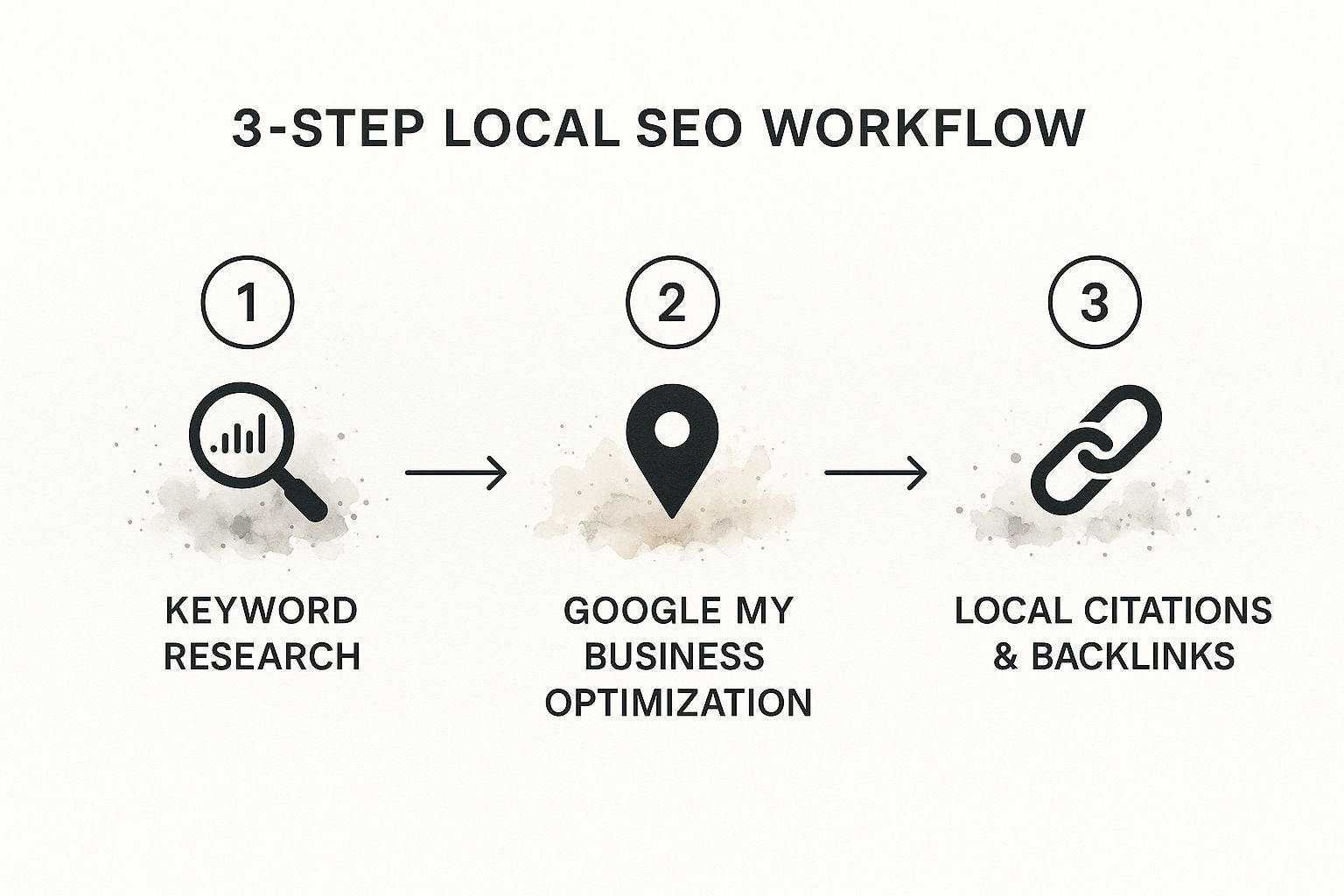
As you can see, optimizing your GBP is the linchpin. It’s the single most impactful action that connects your keyword strategy to your broader online authority.
A well-managed GBP isn't just a listing; it's a lead-generation machine. Here’s a quick checklist of the essentials that can make a huge difference.
Optimizing Your Google Business Profile for Maximum Impact
Your GBP is the cornerstone of local search visibility. Neglecting it is like leaving your physical storefront locked during business hours. This checklist covers the must-do actions to turn your profile into a customer magnet.
| GBP Feature | Optimization Action | Why It Matters |
|---|---|---|
| Complete Core Info | Fill out every single field: services, attributes, accessibility, etc. | Provides a comprehensive snapshot, helping Google match you to highly specific searches. |
| High-Quality Media | Upload clear, professional photos & videos regularly. | Businesses with photos get 42% more direction requests and build visual trust instantly. |
| Review Management | Actively request reviews and respond to all of them (good and bad). | Over 90% of consumers are more likely to use a business that responds to all its reviews. |
| Google Posts | Share updates, offers, and events weekly. | These act like free mini-ads in your profile, catching the eye and driving immediate action. |
| Q&A Section | Proactively ask and answer common questions about your business. | This lets you control the narrative and provide instant, helpful information to potential customers. |
Following these steps consistently signals to both Google and customers that you are an active, engaged, and trustworthy local business.
Creating Hyper-Local Content for Your Website
While your Google Business Profile is the star of your off-site local SEO, your website is the main stage. To truly dominate local search results, you need content that signals geographic relevance to Google. The single best way to achieve this is by building dedicated service-area pages.
A common mistake is listing all service areas on a single page. It’s far more powerful to create an individual page for each specific city or neighborhood you serve.
This tactic laser-targets valuable, location-based searches. For example, an HVAC contractor wanting to serve all of Broward County should build out distinct pages for searches like:
- ‘AC Repair in Fort Lauderdale’
- ‘New Air Conditioner Installation in Pembroke Pines’
- ‘Emergency HVAC Service in Hollywood’
Each of these pages requires unique content. Mention local landmarks, discuss specific neighborhood needs, and tailor the text to that community. This strengthens the geographic signal to Google and, just as importantly, confirms to a visitor that you are the right local expert for their exact needs.
When you combine this on-site strategy with a perfectly optimized Google Business Profile, you create a powerful one-two punch that places you directly in front of more local customers who are ready to buy.
Generating Immediate Leads with Local Paid Ads

While local SEO is your long-term play for building a lasting digital presence, paid advertising is the fast track to growth. Think of it as your on-demand lever for immediate results. It’s the quickest way to bypass organic rankings and place your business in front of customers the moment they’re ready to make a purchase.
With paid ads, you can sidestep the gradual climb of SEO and start generating high-intent calls and leads almost instantly.
In today's competitive market, this is more than an advantage; it's a necessity. The number of small and medium-sized enterprises (SMEs) worldwide has surged, projected to hit 400 million by 2025. With that level of competition, smart advertising is what separates your business from the noise.
For local businesses, two platforms have proven to be the heavy hitters for delivering quick, measurable results: Google Ads and Meta Ads (Facebook & Instagram). They each play a unique but equally critical role in a comprehensive digital marketing for local businesses strategy.
Google Ads: The High-Intent Lead Machine
When someone has an urgent need, they turn to Google.
Imagine a homeowner in Boca Raton discovers a roof leak during a storm. They aren't scrolling social media for a solution. They’re grabbing their phone and searching for "emergency roof repair near me" because they need help now. This is precisely where Google Ads excels.
By targeting specific, high-intent keywords, you position your business at the top of the search results. Google’s Local Service Ads (LSAs) take this a step further.
Local Service Ads are a game-changer for service-based businesses. They appear above traditional ads and organic results and feature the "Google Guaranteed" badge, which builds instant trust with customers.
The best part? With LSAs, you often pay per qualified lead—an actual phone call or message—instead of paying per click. It’s the digital equivalent of being the first number someone sees in a crisis.
Meta Ads: Finding Customers Before They Look For You
If Google Ads is about capturing existing demand, Meta Ads (Facebook and Instagram) are about creating it. These platforms use powerful geographic and demographic targeting to introduce your business to thousands of potential customers in your area who fit your ideal profile, even if they weren't actively searching.
Imagine a new café is opening. They can run a grand-opening campaign targeting people who live or work within a three-mile radius, have "coffee" as an interest, and follow other local restaurants. This builds buzz and drives foot traffic before the doors even open.
Here are a few other ways local businesses can leverage Meta Ads:
- A Realtor: Can showcase a new listing to users in a specific zip code who are flagged as "likely to move."
- A Dental Practice: Can promote a new patient special to everyone within a 10-mile radius of their clinic.
- A Local Boutique: Can build "lookalike audiences" to find new shoppers with similar characteristics to their most loyal customers.
Setting a Realistic Budget and Tracking Success
The key to successful paid advertising is ensuring every dollar spent delivers measurable results. Start with a comfortable budget and focus on one key metric: Return on Ad Spend (ROAS). For every $1 you put into ads, how many dollars in revenue are you getting back?
To maximize your campaign performance, you need a plan for the new leads you generate. A system to automate follow-ups and appointment scheduling can be the difference between a lead going cold and a lead turning into a paying customer. This ensures no opportunity falls through the cracks.
By pairing the intent-driven power of Google Ads with the audience-building prowess of Meta, you create a complete paid advertising strategy that drives both immediate sales and long-term growth.
Building a Loyal Community with Content and Social Media
While paid ads are excellent for generating leads now, a truly durable digital marketing for local businesses strategy is about building a lasting asset. The most successful local businesses aren't just vendors; they become part of the community. This is where content and social media shine—not just as sales tools, but as your primary channels for building trust and loyalty.
The goal is to shift from being "another option" to becoming the go-to resource. When you consistently share expertise and offer genuine value, you create a magnetic pull. Customers won't just call you for a transaction; they'll seek you out for advice. That's how you turn a one-time buyer into a lifelong fan who refers their friends.
Think of it as building an asset that pays dividends long after the initial work is done.
Prove Your Expertise with Value-First Content
Content is your platform to prove you know your industry. You do this not by shouting about your services, but by generously sharing what you know to help people. It’s like having a no-pressure conversation with your ideal customer before they even know they need to hire you.
For instance, a real estate agent in Broward County could write a blog post, "The Top 5 Family-Friendly Neighborhoods in Broward County." This doesn't scream "hire me!" Instead, it offers incredible value to a family considering a move, instantly positioning that agent as a knowledgeable local expert.
The best content doesn't sell—it solves. It answers the questions your customers are already Googling, eases their concerns, and helps them make smarter decisions.
This isn't just a feel-good strategy; it drives business. A remarkable 68% of companies report a better return on investment directly because of their content marketing. Furthermore, with new technology making creation easier, about 67% of small business owners are now using AI to assist with content and SEO. The proof is in the data, which you can explore in these latest content marketing statistics.
Choose the Right Social Media Platform
Trying to be on every social media platform is a recipe for burnout. The key is to be strategic. Go where your customers are already active and focus your energy there. The platform you choose should be a natural fit for your business and your goals.
-
For Visual Brands (Restaurants, Salons, Boutiques): Your home is on Instagram and Pinterest. These platforms are all about visuals. A restaurant can showcase daily specials, while a salon can use Reels to demonstrate a styling technique.
-
For Building Community (Realtors, Home Services): Facebook remains a powerhouse. It's perfect for creating a community group, sharing helpful blog posts, and engaging in local conversations. A local roofer could post timely tips after a storm, building goodwill and brand recognition.
-
For B2B & Professional Services (Accountants, Attorneys): LinkedIn is your primary network. It’s the ideal place to share industry insights, connect with other local business owners, and solidify your professional credibility.
Keep it Real and Engaging
Once you've chosen your platforms, the name of the game is authenticity and consistency. Create content that feels human and invites interaction. If you need inspiration, you can always find great examples on the DigitalAdvertisingDirect.com blog.
Here are a few simple ideas any local business can use:
- Go Behind the Scenes: Show your team in action or introduce a new hire to put a human face on your brand.
- Spotlight Your Customers: With their permission, share a photo and a happy story from a satisfied customer.
- Share Educational Tips: A local landscaper could film a short video on "3 Ways to Prep Your Lawn for Florida's Rainy Season."
- Host an "Ask Me Anything" (AMA): Go live on Facebook or Instagram to answer community questions in real time.
When you pair valuable blog content with genuine social media engagement, you create a powerful marketing engine that builds a loyal community and drives sustainable growth.
Automating Growth and Nurturing Customer Relationships

Generating a lead from your SEO or paid ad campaigns is just the starting line. The real value in digital marketing for local businesses is unlocked in what happens after that first contact. This is where you turn a spark of interest into a loyal customer relationship, and smart automation can be a game-changer.
When local business owners hear "automation," they might imagine complex, expensive software. The reality is much simpler. A Customer Relationship Management (CRM) system acts as your business's perfect memory. It’s a central hub that stores every interaction, detail, and conversation with your customers.
This digital memory fuels effective automation, allowing you to deliver a personal, timely experience that builds loyalty and turns one-time buyers into repeat customers.
Putting Your Follow-Up on Autopilot
When you're busy with day-to-day operations, manual follow-ups are often the first thing to be missed. Automation solves this by ensuring every lead receives prompt attention when it matters most. It’s like having a hyper-organized assistant who never misses a beat.
Consider an HVAC company in Florida. When a homeowner books a service call online, an automated workflow can:
- Send an SMS to confirm appointment details.
- Email a follow-up a day after the job to ensure satisfaction.
- Automatically request a Google review a few days later.
- Tag the customer and schedule a reminder email for their annual tune-up next year.
This entire sequence runs in the background, creating a smooth, professional experience that makes customers feel valued and keeps your business top of mind.
The Power of Simple, High-Impact Workflows
You don't need complex automations to see a real impact. For most local businesses, a few key automated sequences can drive significant growth and improve customer retention.
A well-designed automation system does more than save time. It ensures no lead is wasted and every customer relationship is nurtured, maximizing the lifetime value of everyone who contacts your business.
Consider these high-impact workflows any business can implement:
- New Lead Welcome Sequence: When a lead fills out your form, an automated series of emails or texts can introduce your business, share helpful information, and guide them toward booking a consultation.
- Post-Service Feedback Loop: After a job is completed, automatically ask for feedback. This is a goldmine for testimonials and gives you a chance to resolve any issues before they become negative online reviews.
- Appointment Reminders: Reduce no-shows by sending automated SMS and email reminders before a scheduled meeting or service call. This simple step protects your revenue and keeps your calendar full.
Setting up these strategies is more accessible than ever. For businesses ready to create a seamless client journey, you can get a free strategy session with DigitalAdvertisingDirect to see how a connected system can manage everything from the first click to the final five-star review. By automating your growth, you free up your time to focus on what you do best: running an excellent local business.
Common Questions About Digital Marketing for Local Businesses
Diving into digital marketing often raises many questions. As a local business owner, you need clear, straightforward advice to make intelligent decisions with your time and budget.
Let’s address some of the most common questions we hear from clients to provide the clarity you need to move forward confidently.
How Much Should My Business Budget for Digital Marketing?
This is the most common question, and for good reason. While there's no one-size-fits-all answer, a solid benchmark for established local businesses is to allocate 7% to 12% of total revenue toward marketing.
If you're just starting out or operate in a highly competitive market (like South Florida real estate or home services), you may need to invest at the higher end of that range to gain initial traction.
However, the specific dollar amount is less critical than how you use it. Start smart. Focus your initial budget on one or two channels with proven ROI.
For many local businesses, a focused budget of $500 to $1,500 per month is sufficient to start generating measurable leads, especially when concentrated on high-performers like Google Ads and a fully optimized Google Business Profile.
The most important step is to track your return on investment (ROI) diligently. When you identify what's bringing in customers, you can reinvest profits to scale what works.
What Is the First Step I Should Take in Digital Marketing?
Before spending a single dollar on ads, your first action is non-negotiable: claim and completely optimize your Google Business Profile (GBP).
This is your digital storefront, and it’s free to use. A well-managed GBP is the foundation for nearly all other marketing efforts, directly influencing your visibility in local search and on Google Maps.
Once your GBP is in top shape, your next step depends on your immediate business needs.
- If you need leads urgently: Launch a targeted Google Local Service Ads or Google Ads campaign focused on your primary service. This is the fastest path to getting your phone to ring.
- If you're focused on long-term growth: Begin building a valuable content asset for your business. Create helpful, location-specific blog posts or detailed service area pages on your website. This builds authority and generates organic leads for years to come.
How Can I Tell If My Marketing Efforts Are Working?
You can't improve what you don't measure. In digital marketing, success is defined by tracking the right Key Performance Indicators (KPIs) that align with your business goals. Look past vanity metrics like "likes" and focus on data that impacts your bottom line.
A helpful approach is to pair specific metrics with each marketing channel, recognizing that different channels serve different purposes.
Choosing Your Local Marketing Channel
| Channel | Primary Goal | Time to Results | Typical Cost |
|---|---|---|---|
| Local SEO (GBP) | Build long-term visibility & trust | 3-6+ months | Low (mostly time/effort) |
| Google Ads | Generate immediate, high-intent leads | Days to weeks | Medium to High |
| Paid Social | Build brand awareness & retarget | Weeks to months | Low to Medium |
| CRM Automation | Nurture leads & increase customer LTV | 1-2 months | Low to Medium |
This table provides a snapshot, but the true power lies in integrating these channels. Your SEO efforts can make your ads more cost-effective, while your social media can feed your CRM with new leads. It's all connected.
Should I Do My Own Marketing or Hire an Agency?
This is a classic crossroads for business owners, and the right answer depends on your time and expertise.
Many owners can effectively handle foundational tasks like managing a Google Business Profile or posting on social media. These are great places to start and can be managed in-house.
However, when it comes to channels like Google Ads or advanced SEO, the complexity increases significantly. These are not "set it and forget it" platforms; they require deep knowledge and constant optimization to avoid wasting your budget. An unoptimized ad campaign is one of the fastest ways to lose money.
A smart approach for many businesses is a hybrid model. Handle the basics yourself and partner with a specialist agency when you’re ready to scale with paid ads or tackle competitive search rankings.
Hiring an expert partner isn't just about offloading tasks; it's about achieving a better ROI and freeing you up to focus on running your business and serving your customers.
Ready to stop guessing and start getting measurable results from your marketing? The team at DigitalAdvertisingDirect.com specializes in creating high-performance ad campaigns that deliver qualified leads to your business. Get a free strategy session today and discover how we can build a predictable lead pipeline to fuel your growth.