

Are you still wondering if Facebook ads for realtors are a worthwhile investment? Let's be clear: they absolutely are. But this isn't about simply boosting your latest listing. A truly strategic Facebook ad campaign can become a predictable, scalable lead generation machine, giving you a significant advantage over competitors still relying on referrals and word-of-mouth.
Why Facebook Ads Are a Game-Changer for Realtors

alt text: Realtor showing a young couple a property on a tablet, demonstrating modern real estate marketing.
In today’s crowded real estate market, old-school tactics no longer deliver the results they used to. Relying solely on yard signs and print mailers is a surefire way to get left behind. The modern home buyer and seller begin their journey online, and you must meet them where they spend their time. Facebook provides an unparalleled, direct line to your local community with pinpoint accuracy.
This isn't about vanity metrics like "likes." It's about engineering a reliable system that consistently brings high-quality leads into your pipeline. While your competition waits for the phone to ring, you can be actively putting your brand in front of people showing clear signs they're ready to make a move.
The Power of Precise Targeting
Imagine this: you've just landed a beautiful new listing in Boca Raton. Now, what if you could show that listing exclusively to people within a 15-mile radius who have also been browsing Zillow, using mortgage calculators, or showing interest in first-time homebuyer programs? That’s the kind of surgical targeting that traditional advertising can't match. It means every dollar you spend is working smarter, reaching only the most relevant audience.
The numbers back this up. An overwhelming 90% of realtors are already using Facebook for their marketing, making it the undisputed king of social platforms in our industry. Why? Because it delivers results.
Facebook Ads Performance Snapshot for Real Estate
This table breaks down key performance indicators for real estate ads on Facebook. Think of these as your baseline—the numbers you should be aiming for to know your campaigns are on the right track.
| Metric | Average Figure | What This Means for Realtors |
|---|---|---|
| Average Cost Per Lead (CPL) | $25 – $75 | This is your cost to acquire one potential client's contact info. Keeping this low is key to profitability. |
| Average Click-Through Rate (CTR) | 0.99% | Nearly 1% of people who see your ad click on it. It’s a good measure of how compelling your ad creative is. |
| Average Conversion Rate | 2.47% | This is the percentage of people who take a desired action (like filling out a form) after clicking your ad. |
| Return on Ad Spend (ROAS) | 520% | This is the big one. An average return of $5.20 for every $1 spent shows just how profitable this channel can be. |
These metrics aren't just abstract numbers; they represent a powerful financial reality. A 520% ROAS is proof that with the right strategy, Facebook ads aren't an expense—they're a high-performing investment in your business's growth.
Key Takeaway: Shifting to a strategic approach with Facebook ads transforms your marketing from a cost center into a profit-generating engine. It gives you control and predictability over your lead flow, which is the foundation for scaling any real estate business.
For any realtor serious about growth, mastering Facebook ads for realtors is no longer a nice-to-have; it's essential. The strategies we cover on our Digital Advertising Direct blog and throughout this guide will give you the blueprint you need. By moving beyond simple boosted posts and into strategic campaigns, you build a sustainable advantage that keeps your pipeline full, no matter the market conditions.
Building Your Ad Foundation for Success
I see it all the time: agents get excited about the potential of Facebook ads, jump straight into Ads Manager, and throw money at a campaign without a plan. It’s like trying to build a house without pouring the foundation first—it simply won't work.
If you want your ad spend to be an investment that generates closings, not just an expense, you must get a few critical setup steps right from the very beginning.
First things first, you absolutely must run your ads through a Meta Business Suite (what many of us still call Business Manager). This isn't optional. It’s your professional command center, keeping your business activity completely separate from your personal Facebook profile. This is crucial for security, organization, and allowing you to grant access to team members or an agency without handing over your personal login details.
Inside your Business Suite, you’ll create a dedicated Ad Account for your real estate business. This keeps all your campaign data, billing, and reporting clean and separate. Trust me, you don't want to mix your business ad spend with that one-off ad you boosted for a local charity event.
Here’s a simple visual of how these pieces fit together for a proper launch.
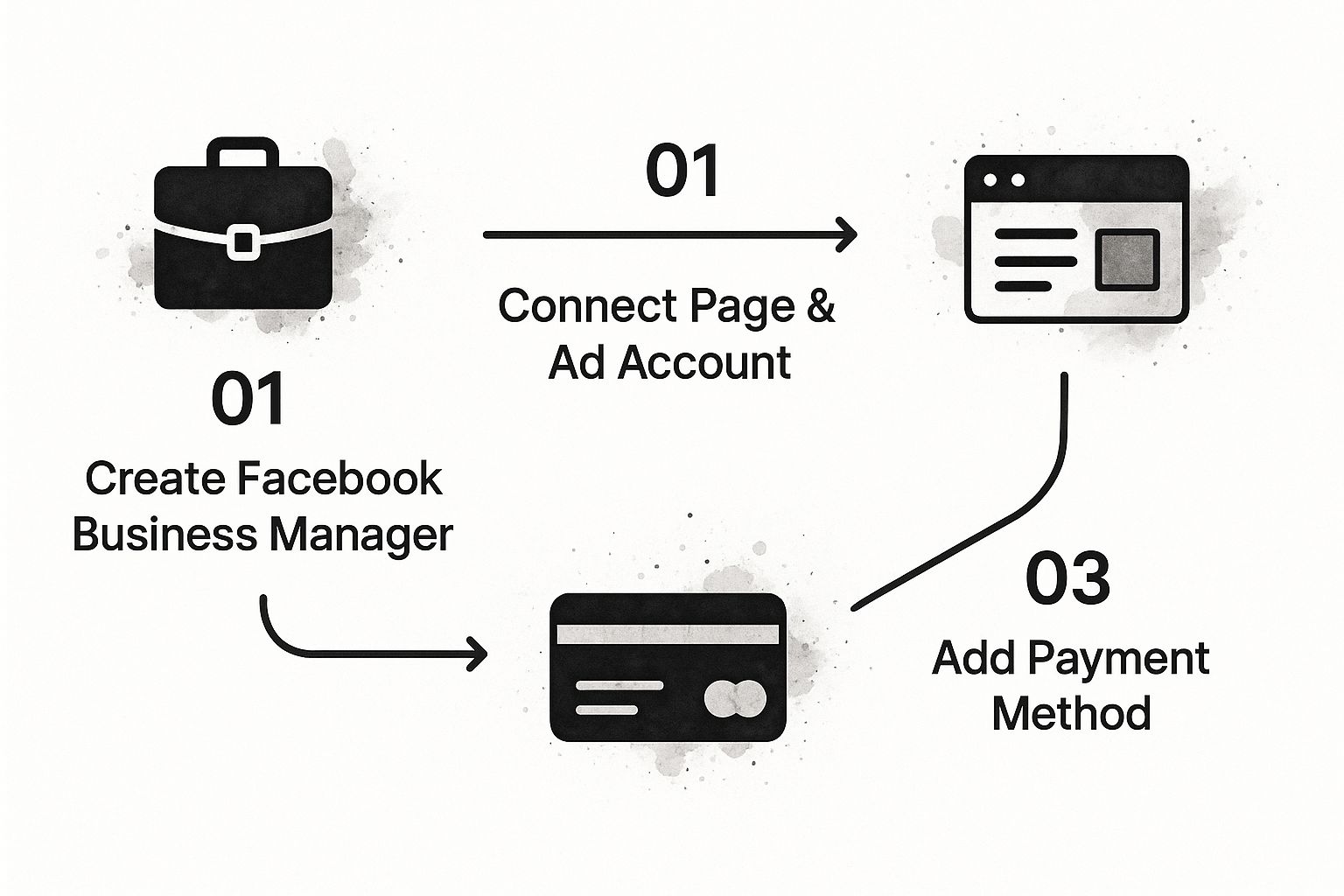
alt text: Diagram showing the structure of Meta Business Suite, with a Business Account containing an Ad Account and a Facebook Page.
Getting this structure right from day one makes tracking your results and managing everything significantly easier down the road.
Defining Clear, Measurable Objectives
With the technical pieces handled, we get to the strategy. What do you actually want to accomplish? "Getting more leads" is a start, but it’s too vague. To build a campaign that works, you need specific, measurable goals.
Are you trying to generate seller leads in a particular zip code? Or are you focused on attracting first-time homebuyers for a new townhome development? Each of those goals requires a completely different ad, message, and strategy.
For realtors, objectives typically fall into one of these buckets:
- Lead Generation: This is the most common goal, and for good reason. The entire point is to collect contact info—names, emails, phone numbers—from potential buyers and sellers who are ready to talk.
- Brand Awareness: Perhaps you're new to the market or want to become the go-to agent for a specific neighborhood. This objective is about getting your face and name in front of as many local homeowners as possible, building crucial name recognition.
- Traffic: Here, the goal is simple: drive clicks to a specific online destination. This could be a new listing page on your website, a blog post about local market stats, or a "What's My Home Worth?" landing page.
Expert Insight: Start with one primary objective. A classic mistake is trying to build a single campaign that generates leads, builds your brand, and drives traffic. You'll dilute your message and confuse Meta's algorithm. Pick one thing—like generating seller leads—and master it before you branch out.
The Meta Pixel: Your Most Important Marketing Tool
Once you know your goal, installing the Meta Pixel on your website is the single most important action you can take for your ad success.
The Pixel is a snippet of code that acts as your private detective. It sits on your website and reports back to Facebook on what people do after they click your ad. It tells you if someone viewed a specific listing, how long they stayed on the page, or—most importantly—if they filled out your contact form. This data is absolute gold.
Without the Pixel, you're flying blind. You’ll know you got clicks, but you'll have no idea if those clicks turned into anything valuable. The Pixel connects your ad spend to real-world results, allowing you to prove your ROI and make smart, data-driven decisions. It also unlocks powerful strategies like retargeting—the ability to show follow-up ads specifically to people who have already visited your website.
Crafting Your Ideal Client Profile
The last piece of your foundation is getting crystal clear on who you're trying to reach. Because real estate is in Facebook's Special Ad Category, you can't target by age, gender, or zip code directly. This restriction forces you to be a smarter marketer.
Instead of basic demographics, you must think about psychographics and behaviors.
- Pain Points: What's keeping your ideal client up at night? For a seller, it might be the fear of listing their home at the wrong price. For a buyer, it could be the frustration of getting outbid.
- Interests: What do they care about besides real estate? A family looking to move to the suburbs is likely interested in pages about local schools, parks, and youth sports leagues.
- Online Behavior: Where do they hang out online? They probably follow local news pages, are members of community Facebook groups, and use apps like Zillow or Redfin.
Let's make this real. An agent in Austin, Texas wants to attract young professionals moving to the city for tech jobs. Instead of targeting an age range, their profile would focus on interests like "downtown condos," "live music," and "local breweries," and they'd target a 15-mile radius around the city center.
This detailed thinking, built on a solid technical foundation, sets the stage for creating Facebook ads for realtors that actually generate business.
Creating Ad Content That Stops the Scroll
In the endless, fast-scrolling world of a social media feed, your real estate ad has perhaps two seconds to make an impact. This isn't just about posting decent photos from the listing. It's about creating a visual and emotional spark that makes someone stop, click, and imagine their life in that home.
The best Facebook ads for realtors work because they cut through the noise. Your ad creative—the blend of your visuals and your words—is your digital handshake. A blurry photo or boring headline is the online equivalent of showing up to a listing with a messy car and a wrinkled shirt. It signals that you don't care about the details, which is the last thing a potential client wants to see.
Crafting Compelling Visuals
The visual is what earns you that initial pause. Let's be clear: high-quality, professional photography is the absolute baseline. It's non-negotiable. But to truly stand out, you need to think beyond static images.
-
Video Tours: There's a reason video is king on Facebook. A well-shot, 30-60 second video walkthrough gives a potential buyer a feel for the home's flow and space that photos can't replicate. Focus on the money shots: the open-concept kitchen flowing into the living room, the backyard oasis, or that stunning primary suite. For properties with land or unique waterfront views, drone footage can deliver a "wow" factor that's worth every penny.
-
Carousel Ads: This format is your best friend for showcasing a property from every angle. It lets you use up to 10 images or videos in a single, swipeable ad. Think of it as a mini-listing that lives right in their feed. A great strategy is to tell a visual story. Start with a killer curb appeal shot, then move inside to the main living areas, highlight a key feature like a brand-new bathroom, and finish with the backyard.
-
Before-and-After Shots: Are you marketing a flip or a home where your staging advice made a huge difference? A simple "before-and-after" image is incredibly powerful. It instantly communicates transformation and value creation, which is what every buyer and seller is looking for.
Pro Tip: Stop selling houses; start selling a lifestyle. If the property has a gorgeous patio designed for entertaining, don't just show an empty slab of concrete. Stage it with tasteful outdoor furniture and string lights. If it's a family home near a great park, a shot of the backyard with a playset can resonate deeply with your target audience.
Writing Copy That Converts
Okay, your amazing visual has stopped the scroll. Now, your words need to close the deal. The mission is to be clear, compelling, and always focus on the benefits for the buyer, not just the features of the house.
Your headline is the most important text you'll write. Ditch the generic "3 Bed, 2 Bath Home for Sale." It's boring and gets ignored. Try something that piques their interest or solves a problem.
- Spark Curiosity: "The Backyard Your Kids Have Been Begging For in [Neighborhood]"
- Focus on the Benefit: "Stop Paying Your Landlord's Mortgage! Own This [City] Home for Less."
- Create Urgency: "Hot New Listing in the [Top-Rated School District] – This One Won't Last!"
In the main ad copy, don't just list specs from the MLS. Weave them into a story. Instead of writing "large kitchen," try, "Imagine hosting Thanksgiving dinner in this spacious, open-concept kitchen, complete with brand-new quartz countertops and a massive island." You're painting a picture they can step into.
Leveraging Immersive Ad Formats
To take your ads to the next level, explore Facebook's more advanced formats. One of the most effective for real estate is the Instant Experience.
When someone taps on an Instant Experience ad, a full-screen, mobile-friendly landing page opens right inside the Facebook app. It's lightning-fast. Inside, you can create a beautiful mini-showcase combining video, photo carousels, and text. This is a game-changer for luxury listings or new construction developments. The best part? The user never leaves Facebook, which makes the experience seamless and keeps engagement high.
The data backs this up. There's a reason 90% of real estate agents use Facebook for advertising—it simply works. Real estate video ads, in particular, see an impressive average view-through rate of 23.31%. Furthermore, well-crafted Facebook ad campaigns can achieve conversion rates near or even above 8%, blowing many other industries out of the water. Agents who master these more engaging, interactive formats see a noticeable jump in lead quality and, ultimately, more closed deals. You can find more social media insights for real estate here.
By bringing together stunning visuals, persuasive copy, and these powerful ad formats, you'll create content that doesn't just stop the scroll—it starts a real conversation with your next client.
Getting Your Ads in Front of the Right People

alt text: Screenshot of Facebook Ads Manager interface showing location and interest targeting options for a real estate ad campaign.
You can have the most stunning video tour or the sharpest headline, but that’s only half the battle. The real power behind Facebook ads for realtors is unlocked when you get that brilliant creative in front of the right people. Great targeting turns your ad spend from a hopeful shot in the dark into a calculated investment that brings in qualified leads.
This is where you graduate from simply "boosting" a post and step into strategic advertising. It’s what separates agents who show a new listing to everyone in a 50-mile radius from those who show it specifically to people actively behaving like homebuyers.
Pinpointing Your Geographic Sweet Spot
First things first: real estate is, and always will be, a local game. Facebook's tools let you zero in on the precise geographic areas that matter to your business.
Because real estate falls under Meta's Special Ad Category for fair housing, you can't target by zip code. The workaround is radius targeting. A simple, effective strategy is to drop a pin on your city's center—or the specific property you’re marketing—and set a 15-mile radius. This casts a net wide enough to capture relevant buyers without wasting your budget on people living too far away.
For example, if an agent in Boca Raton, Florida, is marketing a new waterfront condo, they’d target a 15-mile radius around that property. This ensures their ad hits potential buyers in neighboring affluent communities like Delray Beach and Highland Beach, who are the most likely to be in the market for that type of home.
Tapping Into Behavioral and Interest-Based Signals
Once your location is set, the real magic begins. You can start layering on interests and behaviors that act as digital breadcrumbs, telling a story about who is likely thinking about moving.
Put yourself in the shoes of a potential homebuyer. What websites are they scrolling through? What apps are they using?
Here are a few powerful interest-based targets to get you started:
- Real Estate Portals: Target users who show interest in sites like Zillow, Trulia, or Realtor.com. This is the most direct signal you'll find.
- Financial Indicators: Look for people interested in "mortgage loans," "mortgage calculators," or "pre-qualification (lending)." This is how you find people who are actively figuring out their budget.
- Life Events: While you can’t target by specific age, you can find audiences based on life milestones. Targeting interests related to "getting married" or "newly engaged" is a great way to find future first-time homebuyers.
Expert Insight: Resist the urge to stack dozens of interests on top of each other. Instead, create separate ad sets to test different interest groups. For example, run one ad set targeting Zillow users and another targeting people interested in mortgage calculators. This shows you which audience performs better so you can put your money where it counts.
Unlocking the Pro-Level with Custom and Lookalike Audiences
Ready to move into the big leagues? Custom Audiences and Lookalike Audiences are your secret weapons for achieving an exceptional return on your ad spend.
A Custom Audience is built from your own data—your warm audience of people who already know you. The most valuable custom audience for any realtor is a list of past clients' emails and phone numbers. You upload this list, and Facebook securely matches the data to user profiles. Now you can run ads directly to them to ask for referrals or market new listings.
But the real power move is what comes next.
Once you have a solid Custom Audience of at least 100 people (your past buyers are perfect for this), you can create a Lookalike Audience. You’re basically telling Facebook, "Go find me more people who act just like my best past clients."
The platform's algorithm analyzes thousands of data points—demographics, interests, online behaviors—of the people in your source audience. It then builds a massive new audience of people who share those traits but haven't met you yet. This is, hands down, one of the most powerful tools available for finding high-quality buyer and seller leads.
This kind of advanced targeting is why Facebook ads are so valuable for realtors. Imagine combining a powerful Lookalike Audience with an engaging Instant Experience ad. This creates an incredibly effective lead funnel. Recent benchmarks show the median return on ad spend for U.S. real estate ads is around 0.64. While results vary, this shows that a well-tuned campaign, especially when you can recover lost lead data with the right tracking, can drive serious business at a low cost.
By mastering these targeting layers—from a simple radius to a sophisticated Lookalike—you ensure your message doesn't just get seen. It gets seen by the right people at the exact moment they're ready to make a move.
How to Optimize Your Campaigns for Maximum ROI
Launching your real estate ad campaign is just the starting line. The real work—the stuff that separates a campaign that spends money from one that makes money—starts now. This is where you roll up your sleeves and turn a decent campaign into a predictable lead-generation machine through continuous, data-driven optimization.
It might sound intimidating, but it all comes down to a simple idea: listen to what your data is telling you. When you regularly dive into your Facebook Ads Manager dashboard, you can stop guessing what works and start making strategic decisions that directly impact your bottom line.
Key Metrics Every Realtor Should Watch
Your Ads Manager is swimming in data, but you only need to focus on a few key metrics to get a clear picture of your facebook ads for realtors. Don't get distracted by vanity metrics like reach or impressions. Instead, zero in on the numbers that actually mean something for your business.
These are the non-negotiables:
- Cost Per Lead (CPL): This is your north star for lead generation. It tells you exactly how much you're paying to get one person's contact information. Your mission is to drive this number as low as possible without sacrificing lead quality.
- Click-Through Rate (CTR): This metric tells a big story. It’s the percentage of people who see your ad and click on it. If your CTR is below 1%, it's a huge red flag that your ad creative isn't grabbing attention.
- Return on Ad Spend (ROAS): This is the ultimate measure of investment. ROAS tells you how many dollars in commission you're generating for every dollar you spend. It's tougher to track without a solid CRM but is the truest indicator of success.
Keeping an eye on these three metrics will give you a constant pulse on your campaign's health.
The Power of Systematic A/B Testing
One of the biggest mistakes agents make is creating one ad, hitting "publish," and hoping for the best. The pros are always testing. A/B testing, or split testing, is simply running two slightly different versions of an ad to see which one performs better. It's the fastest way to figure out what your audience actually responds to.
Pro Tip: When you're A/B testing, only change one variable at a time. If you test a new image and a new headline in the same ad, you'll have no idea which change actually moved the needle. Be methodical.
Not sure where to start? A/B testing is all about asking "what if?"
A/B Testing Ideas for Realtor Facebook Ads
This table gives you a practical roadmap for systematically testing and improving your ads. Use this structure to find out what truly resonates with your target audience.
| Element to Test | Variation A (Control) | Variation B (Test) | Metric to Watch |
|---|---|---|---|
| Primary Image | Professional photo of the home's exterior | Video walkthrough of the interior | Click-Through Rate (CTR) |
| Headline | "Just Listed in Austin, TX" | "The Backyard Your Kids Have Been Begging For" | Cost Per Lead (CPL) |
| Audience | Interest: "Zillow" & "Trulia" | Lookalike Audience from Past Buyers | Cost Per Lead (CPL) & Lead Quality |
| Call-to-Action | "Learn More" | "Get Offer" | Conversion Rate |
This methodical approach takes the guesswork out of the equation. You're no longer operating on hunches; you're making decisions based on cold, hard data, which is how you continuously improve your results over time.
Smart Budgeting and Scaling Strategies
Managing your budget is where strategy meets reality. When you first launch a new campaign, give it some breathing room. Let it run for at least 3-5 days before making any major tweaks. This gives Meta's algorithm enough time to exit its "learning phase" and gather the data it needs to start optimizing delivery.
Once you’ve found a winner—an ad with a low CPL and great engagement—it's tempting to throw a ton of money at it. Don’t. Suddenly doubling or tripling the budget can shock the algorithm and send performance spiraling. The right way to scale is gradually. Increase the budget by no more than 20-25% every few days.
This is also a perfect use case for Campaign Budget Optimization (CBO). With CBO, you set a single budget at the campaign level, and Facebook automatically allocates it to the best-performing ad sets in real time. It’s a fantastic way to ensure your money is always working its hardest.
For agents who want to put this entire optimization process on autopilot, more advanced platforms can be a game-changer. For instance, our proprietary Adfuel Plus program at Digital Advertising Direct uses AI to manage and optimize campaigns, ensuring your budget is always allocated for maximum impact without all the manual heavy lifting.
By combining careful metric analysis, disciplined A/B testing, and smart budget management, you create a repeatable system for improvement. This is how you stop hoping for leads and start building a predictable pipeline that fuels your business growth month after month.
Your Blueprint for Facebook Advertising Success

alt text: A realtor handing keys to a happy couple in front of their new home, symbolizing a successful outcome from a strong marketing strategy.
We've walked through the entire playbook for a winning Facebook advertising strategy. This guide is the framework for your real estate business—from setting up a solid foundation and creating ads that grab attention to zeroing in on the right audience and optimizing campaigns for maximum profit.
Getting results with Facebook ads for realtors isn't about getting lucky. It’s about following a methodical, strategic process.
Real growth and a predictable flow of clients come from consistency and a relentless commitment to testing. Every piece of the puzzle, from how you set up your ad account to your final A/B test, snaps together to build a powerful lead generation engine for your business.
Your success is built on the daily habits of analyzing data, refining your creative, and understanding what truly motivates your audience. It's an ongoing cycle of learning and improving that separates top-performing agents from the rest.
By putting these principles into action, you stop just spending money on ads and start making calculated investments in your business's future. This is how you gain control over your lead flow, giving you the power to scale your operations and hit your ambitious income goals.
Need help attracting quality real estate leads? Get a free strategy session with DigitalAdvertisingDirect.
Frequently Asked Questions
When diving into Facebook ads for realtors, many questions pop up. Let's tackle the most common ones we hear from agents so you can feel more confident about your ad spend.
How Much Should a Realtor Spend on Facebook Ads?
There's no one-size-fits-all answer, but a solo agent just getting started should consider a budget between $300 and $600 per month. That's typically enough to start collecting data on what connects with your audience.
A smarter way to think about it is to work backward from your income goals. For example, if your average Cost Per Lead (CPL) is about $20 and your goal is to bring in 25 new leads this month, you’ll need a budget of at least $500 to hit that target.
Key Takeaway: Start with a budget you're comfortable with and focus on proving your return on investment. Once you see which campaigns are filling your pipeline with quality leads, you can confidently scale your spending.
Are Facebook Lead Forms Better Than a Website Landing Page?
It depends. Both have a valuable role in a well-rounded advertising strategy.
- Facebook Lead Forms: These are excellent for generating a high volume of leads, often at a lower cost, because people can submit their info without leaving the Facebook app. The trade-off? The convenience can sometimes bring in leads who are less motivated or just casually browsing.
- Website Landing Pages: Sending traffic to a custom page on your website almost always results in higher-quality, more serious leads. These individuals have taken an extra step to click away from social media, signaling stronger interest.
The best approach is to use both strategically. Use Lead Forms for top-of-funnel offers, like a free home valuation guide. For more serious, high-intent prospects, drive them to a dedicated landing page to schedule a showing for a specific listing.
Why Are My Real Estate Ads Getting Rejected?
This is a common issue. Facebook places all housing-related ads into a "Special Ad Category" to ensure fair housing practices and prevent discrimination. Because of this, you cannot target by age, gender, or specific zip codes.
Most often, if your ad gets rejected, it’s because you forgot one simple step: selecting the "Housing" category when you first set up the campaign. You must declare this at the campaign level, right from the start, to comply with Meta's advertising policies.
So, how do you succeed with these rules? Shift your thinking. Instead of hyper-targeting, go for broader locations, like a 15-mile radius around your city. Then, build your audience using powerful interest-based targeting, like people interested in "Zillow," "Trulia," or "first-time homebuyer grants."
If you're still hitting a wall or want an expert to look over your shoulder, you can always book a free strategy session with us. We’ll take a look at your campaigns and help you get back on track.